


In short: A Listen & Repeat score is a verdict, not a diagnosis. Every mistake belongs to one of three layers — Listening, Pronunciation, or Expression — and each needs a different fix. A single band hides which one you’re losing points to. Naming the layer is what makes the score actionable.
A real TOEFL Listen & Repeat attempt scored 4.0. Under that one number sat 21 separate problems — and they split into three completely different kinds of failure.
A score tells you where you stand. It doesn’t tell you what to fix. Those are different jobs, and for a long time our report did only the first one — a transcript and a number, the same flat shape as every other prep tool.
This post is about the second job: turning a number into a diagnosis you can act on.
A score is a verdict, not a diagnosis
Here’s the problem with “4.0.” Two students can earn the same band for opposite reasons. One heard every word but mangled the sounds. The other pronounced cleanly but dropped half the sentence. Same score, nothing in common.
Repetition doesn’t fix this either. Saying a sentence ten more times reinforces whatever you were already doing — including the mistake. We wrote a whole separate piece on why 10 reps fix nothing; the short version is that practice without a target is just rehearsal of your errors.
So the real question isn’t “what’s my score.” It’s “which part of me broke, on which sentence, and what do I do about it.” To answer that, you have to break a repeated sentence into the places it can go wrong.
Three reasons a repeated sentence goes wrong
Repeating a sentence is a chain: you hear it, you hold it, your mouth produces it, and your voice delivers it. A mistake is a break somewhere in that chain — and where it breaks decides how you fix it.
There are three break points. We tag every Listen & Repeat issue with the one it belongs to.
| Layer | Where the chain broke | What it actually is | The fix it needs |
|---|---|---|---|
| Listening | Ear | You never caught the sound | Shadowing, predicting reduced words |
| Pronunciation | Mouth | You caught it, but can’t form it | Minimal pairs, articulation drills |
| Expression | Voice | Words are right, delivery is flat | Mimic the melody and stress |
The classification isn’t a guess. It’s computed in code from the gap between what you heard and what came out — not handed to a language model to label by vibe. That matters, because the layer is the thing that routes you to the right practice. Get the layer wrong and you drill the wrong weakness.
Each layer fans out into specific, named issues, and the rest of this post walks one real example from each. The 4.0 attempt above had all three.
Listening — you never caught it
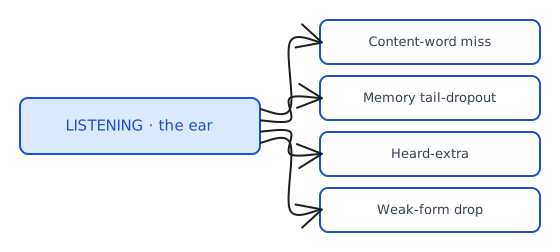
On one sentence, an entire word vanished.
The sentence: “All desks have power outlets for your laptops.”
What the report caught: the word “your” was dropped entirely.
“Your” here isn’t said the careful way it looks on the page. In natural speech it reduces to a quick /jər/, leaning on the words around it. It went by too fast and too light, and the ear never registered it. No amount of pronunciation practice fixes that — you can’t pronounce a word you didn’t hear.
Missed words are only half the story. The other half shows up as sentences get longer. Here’s a 14-word one:
The sentence: “If you need assistance, look for one of our volunteers wearing a bright badge.”
What the report caught: the opening held, but the back half came apart — “look for one of” dropped, and “wearing a bright badge” came back as entirely different words.
A Listen & Repeat set grows from a few words to fifteen or more, and somewhere past about seven, working memory runs out: the opening survives, the tail collapses. That dropout is a different failure from a slipped “your,” and it needs a different fix.
So the ear splits into two repairs. For weak forms, shadow at full speed and train yourself to expect small words (“your,” “of,” “and”) to shrink rather than ring out. For a collapsing tail, stop drilling words and start chunking — hold the sentence as two or three sense groups (“Upstairs, the media room” + “has laptops you can borrow”), not nine separate ones.
What we tag under Listening:
Pronunciation — you caught it but can’t say it
Most of the 21 problems were here — the mouth, not the ear.
The sentence: “Welcome to the library.”
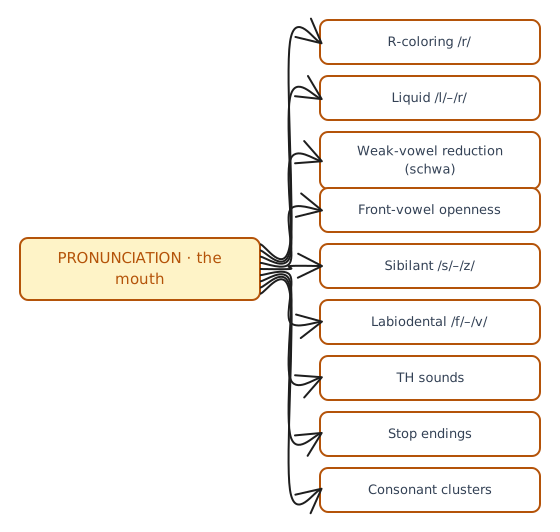
What the report caught: the /w/ and /ɛ/ in “welcome” and the /l/–/r/ sounds in “library” weren’t clearly formed.
This student heard the sentence fine. The breakdown was physical: lips not rounding for /w/, tongue not finding the spot behind the teeth for /l/ versus the curl-back for /r/. These are muscle habits, and they need muscle practice — minimal pairs like “light/right,” the word said slowly, then at speed.
Pronunciation is the layer most prep tools stop at, because mispronounced sounds are the easiest thing to flag. But flagging “/r/ was unclear” isn’t the same as separating it from the word you never heard, or the word you said flatly.
What we tag under Pronunciation:
Expression — you said it, but flat
The third layer is the sneakiest, because nothing is technically wrong.
The sentence: “Before leaving the library, please return any borrowed materials.”
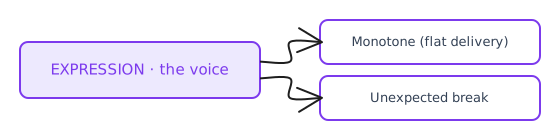
What the report caught: the words were all there, but “leaving,” “library,” and “materials” came out flat — no pitch movement, no stress.
Every word was correct and clearly pronounced. What was missing was the melody — the rise and fall that makes English sound like speech instead of a list. This is delivery, and on the 2026 TOEFL it’s part of what the scoring engine measures (we broke down how AI grades Speaking separately).
The fix isn’t a sound or a missed word — it’s imitation. Shadow the original, exaggerate the pitch changes on the stressed syllables, and let the sentence move.
What we tag under Expression:
Why the layer matters more than the score
Look at those three again. A missed word, a mangled consonant, and a flat line — three failures that a single “4.0” treats as identical, and that three different drills repair.
That’s the whole argument. The score ranks you. The layer tells you what to do Monday morning. A report that gives you only the first has handed you a verdict and kept the diagnosis to itself.
So a report should do four things a bare score can’t:
- Name the sentence the problem lives on, not just the overall band.
- Name the cause — which of the three layers broke.
- Let you hear the gap — play the original against your own recording, back to back, so the difference is audible and not just described.
- Let you retry that one issue and compare, instead of re-recording the whole set and hoping.
None of that is exotic. It’s just what diagnosis looks like when you take it seriously — and it’s the difference between knowing your score and knowing your next move.
What this means for your prep
Next time you do a Listen & Repeat practice, don’t ask “what did I get.” Ask three questions in order:
- Did I hear every word? If a word is missing, that’s Listening — go shadow, don’t drill sounds.
- Could my mouth make the sounds? If a word is there but mangled, that’s Pronunciation — minimal pairs and slow articulation.
- Did it sound like speech? If the words are right but flat, that’s Expression — mimic the melody.
A score can’t answer those for you. The point of a report is that it should. For the band ranges themselves and what counts as a good one, see what’s a good TOEFL Speaking score.