


Ten reps of Listen and Repeat won’t move your next attempt if every rep targets the whole sentence. The fix is a five-step loop: listen, repeat, diagnose the smallest break, drill only that, verify it held. The rest of this post walks through what to listen for, what to fix, and what to skip — so each rep changes the next.
What is Listen and Repeat
Listen and Repeat is the first task type on the redesigned TOEFL Speaking section. You hear seven sentences of progressively longer length, then say each one back once after a brief pause and beep. No prep time. No second listen.
| Spec | Value |
|---|---|
| Item count | 7 sentences (Q1–7) |
| Sentence length | 9–11 syllables (early) → 19–23 syllables (late) |
| Time per response | About 5 seconds, no prep |
| Total section time | Roughly 3 minutes |
| Scoring | Accuracy + intelligibility, contributing to the section’s 1–6 band |
Most test-takers come at this drill as if it were pronunciation work. It isn’t — at least, not only. The hard part is the ear: working memory for mid-length sentences, and recognizing at natural speed the words you’d otherwise only know on paper. Pronunciation is downstream.
The old way: repeat the whole sentence again
Most people run this drill like this:
- Listen to the sentence.
- Repeat it.
- Look at a score.
- Repeat the whole sentence again.
It isn’t useless, but it usually turns into guessing. Say the sentence was “The professor said the policy would affect first-year students,” and the score dropped. What should you actually fix?
You might have missed “would.” “Affect” might have sounded like “effect.” The pause after “policy” might have been too long. The end of the sentence might have faded.
If feedback stays at the sentence level, the only thing you can do is try the whole sentence again and hope it lands better. That’s not practice. That’s repetition.
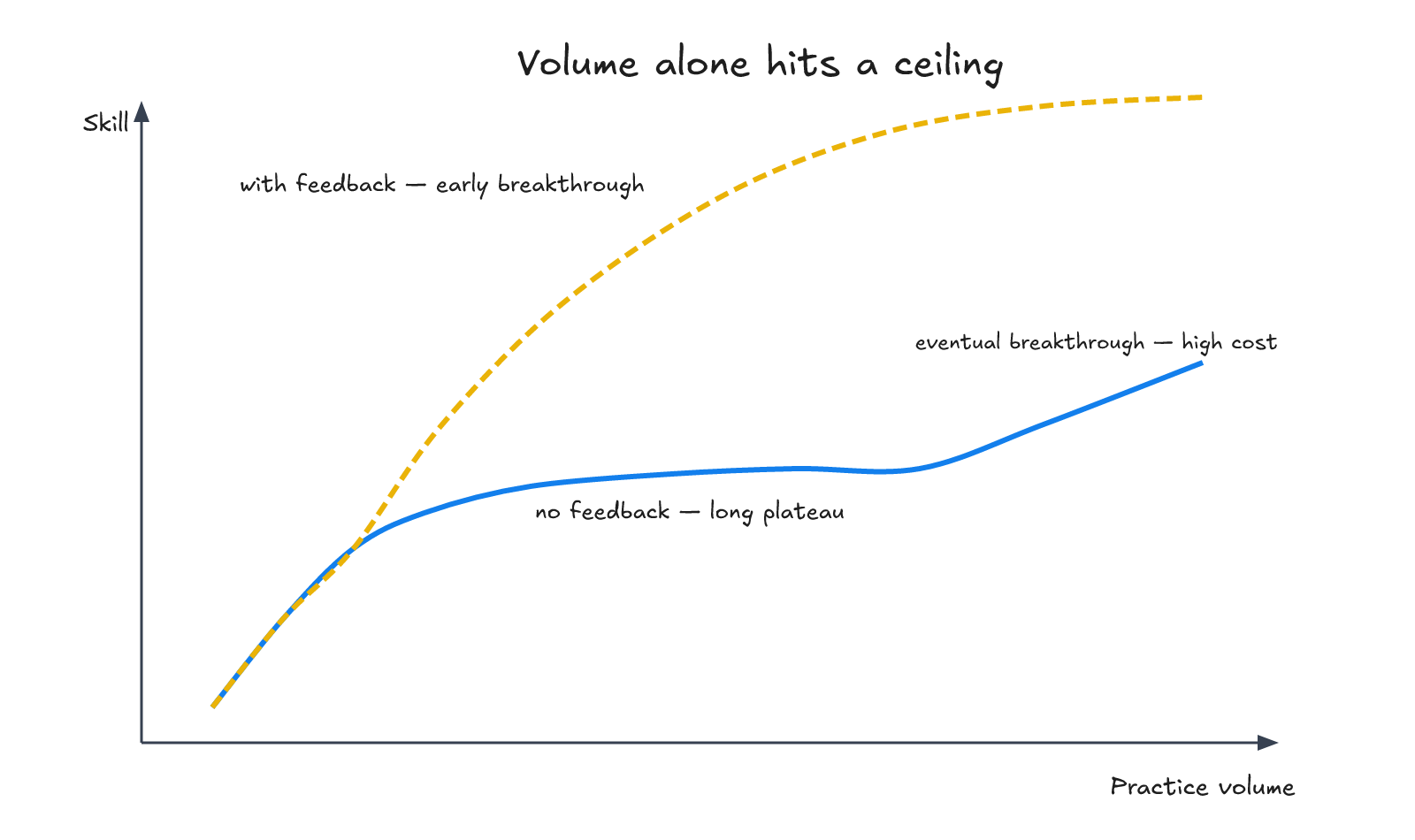
And there’s a ceiling. You can push the volume up — 50 sentences a day, 200 a week — and for a while you’ll feel like you’re getting better. Then you hit a plateau.
More repetitions stop translating into more skill, because without feedback pointed at the right thing, every rep just lays down the same micro-habit. The breakthrough doesn’t come from doing more of the same — it comes from doing the right next thing.
The loop that works: diagnose, target, compare
A useful version of this drill is a closed five-step loop. Each pass targets a single issue:
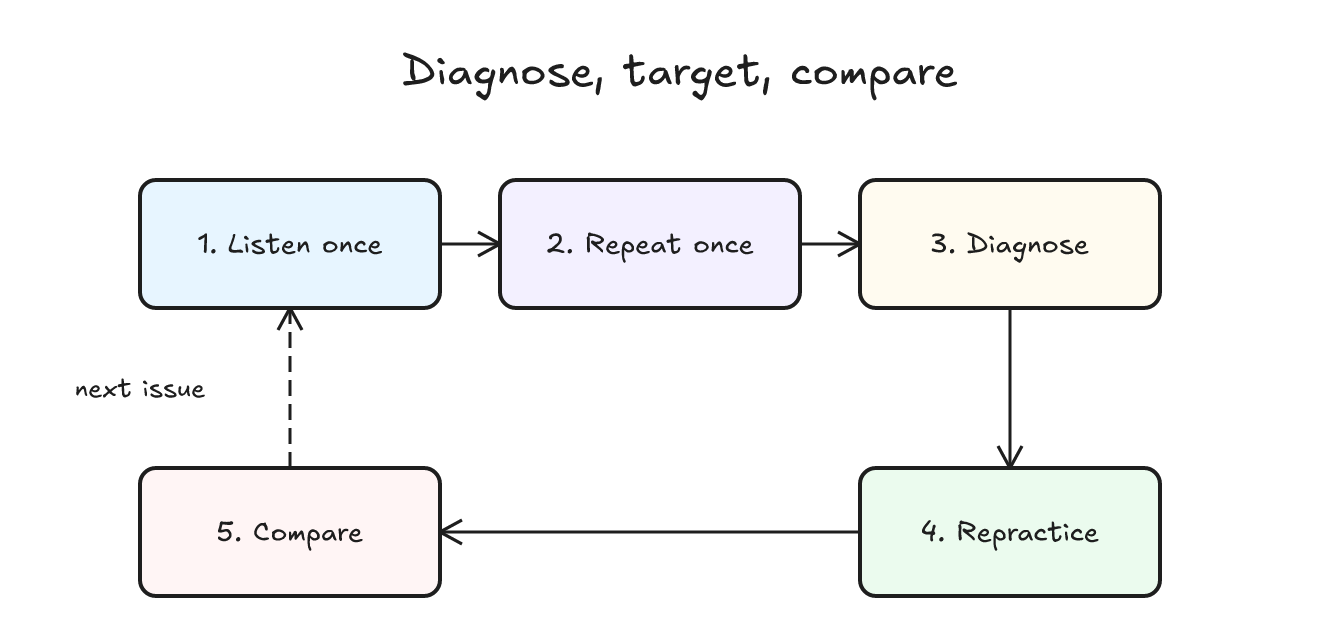
1. Listen once
Let the whole sentence play through at natural speed. Don’t pause every two words — the first listen is the most honest signal of what your ear can and can’t follow.
Source sentence: “The professor said the policy would affect first-year students.”
Played once at natural speed. No pause. No replay.
Most test-takers treat Speaking practice as pronunciation work, but Listen and Repeat is just as much ear training: working memory for mid-length sentences, and recognizing at natural speed the words you’d otherwise only know on paper.
2. Repeat once
Say it back in full, at natural speed. A complete repeat trains what drilling individual words can’t reach: your brain coordinating listening and speech in real time, and the connected speech — linking, elision, rhythm, intonation — that only lives inside whole sentences.
First attempt (out loud, no script): “The professor said the policy […] affect first-year students.”
“Would” dropped. The pause after “policy” went too long. The rest landed.
The first attempt is the most honest signal of what your listening and speech system actually captured. After that, memory colors every retry. No script, no second attempt up front.
3. Diagnose, narrowly
Pick the issue that costs you the most points. The instinct is to fix everything at once — missing word, wrong stress, dragged pause, fuzzy consonant — but each fix takes attention from the others, and you end up with no clean change on any.
Candidate fixes:
- Bring back “would” (missing word)
- Tighten the pause after “policy” (rhythm)
- Sharper stress on “first-year” (dropped ending)
You pick: bring back “would”. Missing words cost the most per spot; the rest can wait.
Which fix would most clearly move the next attempt in a listener’s ear? That’s the one you take into repractice — not the one that annoys you most, not the one easiest to fix.
4. Repractice only that
Lock onto the issue you picked and drill it until it’s clean. Not the whole sentence over again — just the spot that broke. Narrower, not louder. Keep grinding the same micro-fix until the muscle memory settles.
Drilling target: “…the policy would affect…”
Listen. Say. Listen. Say. Three to five focused micro-reps until “would” sits in.
Skip the rest of the sentence — it’ll only steal attention.
5. Compare before and after
Run two checks against the first attempt. The spot you targeted should have moved in a way you can hear. The rest of the sentence should have held steady — no new issue introduced by the fix. Until both are true, you don’t yet know whether the repractice helped.
First attempt: “…the policy […] affect first-year students.”
Second attempt: “…the policy would affect first-year students.”
The target landed. The pause didn’t drift. The fix held — move on.
This is closer to how a good speaking coach works. A coach doesn’t say “practice more.” A coach stops you at the exact place where the answer broke, makes you redo that part, and then checks whether anything actually changed.
What to focus on inside a repractice
A good repractice attempt is narrower than the first one, not louder. You’re drilling one issue with focused reps — listen, say, listen, say — until the muscle memory settles. What “drilling” looks like depends on the kind of issue:
| Drilling approach | Common trap | |
|---|---|---|
| Missing word | Hold the sentence in chunks before you start; replay the prompt once; give the target phrase a little extra room | Slowing the whole sentence down |
| Unclear sound | Slow only around the sound; aim for clear articulation in natural speech | Robotic over-pronunciation — listeners forgive a slower consonant, not a robot |
| Fluency | Carry the phrase through the spot where you broke; cross the issue at speed | Over-pausing before the word — swaps one problem for another |
The point isn’t to memorize three rules. It’s to notice that the kind of fix depends on the kind of issue — pick the right move, then run reps until it sticks.
Common mistakes
- Repeating the whole sentence after every score. The default trap this post opens with. The fix is in The loop that works — diagnose narrowly, drill only the broken spot.
- Memorizing the sentence after the first listen. If you mentally rehearse the words before saying them, you’re testing memory, not the ear-to-mouth pipeline. Say it back without inner rehearsal; what comes out is the honest signal.
- Slowing the whole sentence to fix one bad word. This trades a clean local problem for a uniform slowdown across the sentence. Listeners hear the drag everywhere and treat it as worse, not better.
- Stopping the micro-reps too early. A targeted spot usually needs three to five focused reps before it lands cleanly. Two reps and “good enough” doesn’t reset the muscle memory.
That’s the actual method behind Listen and Repeat, and you can run it on a full set in our Listen & Repeat practice. Listen all the way through. Repeat honestly. Diagnose the smallest thing that broke. Fix only that. Then check whether the fix held.
The goal isn’t a perfect score on any single practice. It’s to leave each session with one observable correction you can carry forward — into the next sentence, into a full Speaking answer, into the next session.