


The TOEFL Writing for an Academic Discussion task gives you 10 minutes and a blank box, and most guides hand you a template to fill it. The template is fine. The problem is what students do with it: they paste in a memorized shell and fill the gaps with whatever fits. That answer is exactly what the scoring guide is built to catch.
This task is graded on contribution — whether you add something the other two students didn’t. A template can organize that contribution, but it can’t be the contribution. This guide shows you the difference, with one prompt worked all the way through.
What the academic discussion actually is
You’ll see a professor’s question on a class discussion board, with two students who have already posted opposing replies. You write the next post.
| Element | Detail |
|---|---|
| Time | 10 minutes total — read, plan, write, proofread |
| Word count | At least 100 words; strong answers run 120–180 |
| On screen | Professor’s question + 2 student posts (opposing views) |
| Your job | Add your own opinion, supported, in your own words |
| Score | Rated against ETS’s Academic Discussion scoring guide, 5 down to 0; your Writing section score is reported on the 1–6 band (2026) |
That last row matters more than it looks. Your post is judged as one whole against the guide’s descriptors, not against a checklist of structural moves. Nothing in those descriptors is about your paragraphing, your word count, or the other two students. (Below, “a 5” means the top level of ETS’s scoring guide for this task.)
Why the template caps your score
Read what ETS actually rewards at the top of the scale. A 5 is “a relevant and very clearly expressed contribution to the online discussion.” It carries “relevant and well-elaborated explanations, exemplifications and/or details.” At the bottom, the score-1 descriptor names the opposite: “minimal original language; any coherent language is mostly borrowed from the stimulus.”
So the bar is relevance plus elaboration. Relevance means relevant to the professor’s specific question, and elaboration means one idea taken down to a reason and a concrete case. Neither is a property of your template.
Now look at what a fill-in template produces. “While some people might think X, I really believe Y. First of all, …” is a shell identical across ten thousand test-takers, signaling structure and nothing else. When the only specific content is lifted from the two student posts, you’ve written the exact answer the scoring guide penalizes.
So here’s the honest role of a template: it’s scaffolding for your thinking, not a script to recite. Use it to decide where your opinion goes and where your reason goes, so you don’t waste 3 of your 10 minutes on structure. Then throw real ideas into the slots — ideas that engage the discussion. The points live in the ideas, never in the scaffolding.
The test: if your answer could be pasted under a different prompt with two words swapped, it’s a template talking. If it only makes sense as a reply to these two students, it’s a contribution.
Do you have to mention both classmates?
No. “Name both classmates” is a template rule as well, and ETS never wrote it.
Magoosh’s 2026 guide lists “Always mention both classmates by name” under common mistakes, then says two sections earlier that agreeing with one and disagreeing with the other “is not technically required.” An earlier version of this guide told you to engage both by name as well. Here is what the official documents say instead.
The Academic Discussion scoring guide runs from 5 down to 0. Across all six descriptors, in both the 2023 edition and the current one, no classmate is mentioned. Neither is agreeing, disagreeing, or a counterargument. The on-screen directions don’t mention the other students either: they ask you to express and support your opinion, and to make a contribution to the discussion in your own words.
Then there’s what ETS publishes as a scored answer.
| ETS-published sample | Score | Words | Classmates named |
|---|---|---|---|
| Vaccines (2023 practice sets) | 5 | 171 | none |
| Volunteerism (2026 Test Overview) | 5 | 120 | one, the one it disagrees with |
| Light bulb (2023 practice sets) | 4 | 109 | none |
The vaccines response is the striking one. The professor asked for an important invention of the past 200 years; Paul had posted about satellites and Claire about vitamins. The answer goes past both of them and writes about Pasteur, a third topic nobody raised.
ETS’s rater commentary calls it “a relevant contribution to the discussion” and explains the score entirely through elaboration: life before the vaccine, millions of lives saved, lifespans extended. Naming Paul or Claire never comes up.
The 2026 sample does reference a classmate, and it’s worth seeing how little that reference costs. It opens “While I get Andrew’s point about limited free time, I think…” — one subordinate clause, aimed at the student it disagrees with. Claire, whose side it actually takes, is never named.
ETS’s own video settles the question in a sentence: you “may refer to one of the other student posts to agree or disagree,” or you can write about “something completely different.” Modal verb, and one of two.
So what is being scored? ETS’s teaching materials name three moves, and none of them involves a classmate:
- State your opinion.
- Explain why you hold it, with details and examples to support it.
- Further the discussion by adding a new perspective, or asking your own question.
Move 3 is the one people mistake for classmate engagement. Furthering the discussion means adding something it didn’t already contain; ETS’s Response Tips put the obligation the other way round, telling you to “add your own perspective… not merely repeat ideas that have already been stated.” Referring to a classmate is one legitimate route there, and a reference aimed at a specific point reads well. It is not a box the scoring guide ticks, and leaving it out costs you nothing.
One prompt, worked through
Here’s the prompt we’ll build an answer for. Keep your eye on it — every step below works on this same example.
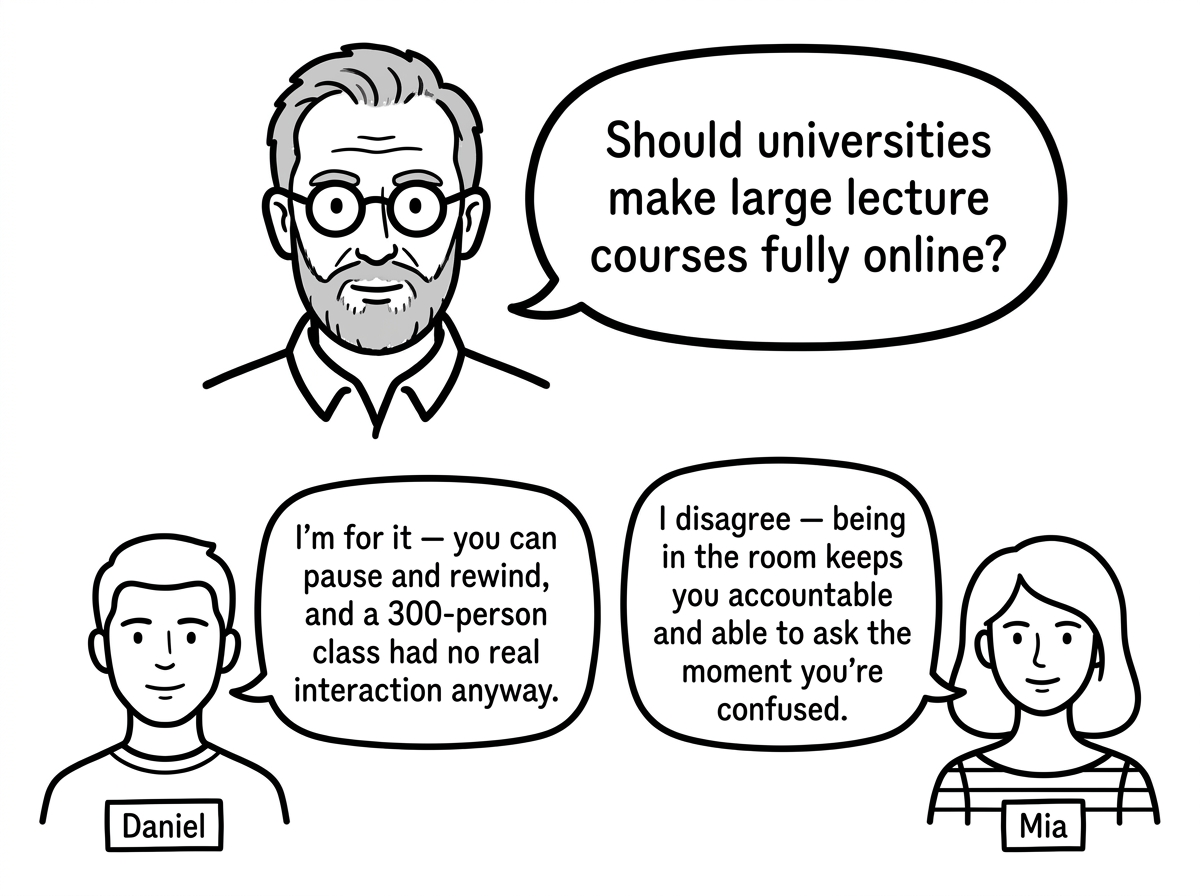
Two clear sides, and this is where most answers go wrong. The template-filler skims the two posts, picks whichever side is easier to write about, and restates it in slightly reworded sentences. It looks like an answer. It scores like filler, because everything specific in it was already on the board: no new perspective, and the only vivid language is borrowed.
The fix isn’t better vocabulary. It’s four small moves that turn a monologue into a contribution: read for the seam where the two students disagree; commit to a side; add the one point neither of them made; then answer the other side if you have room.
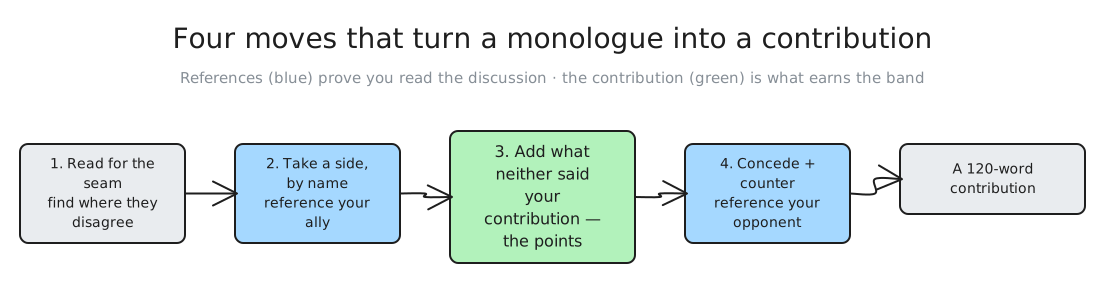
This is our scaffold, not ETS’s spec. Only the green move is doing the scoring work; the two blue moves reference a classmate, and you saw above that ETS’s own Score-5 answers get by with one of those or none. We teach them anyway because under a 10-minute clock, reacting to a specific post is the fastest way to produce a sentence that couldn’t be pasted under any other prompt. Take the blue moves if they help you think, and drop them if they don’t.
Step 1 — Read for the seam
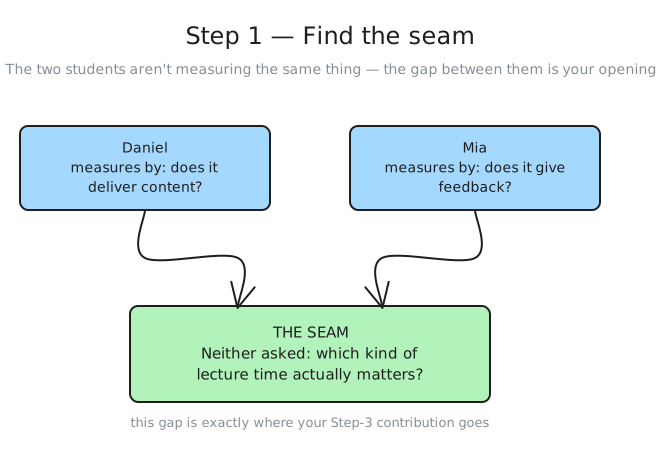
Before you pick a side, run the seam test: boil each post down to a single phrase, then find the one question the two students answer differently. That gap between their yardsticks — the seam — is your opening, and it’s where your whole contribution will aim.
In your first minute or two, jot a two-line map (in your head, or on the scratch area):
Daniel → efficiency — a recording delivers content well
Mia → feedback — being there keeps you accountable and lets you ask live
Now read the two phrases side by side. Daniel is judging “online” by how well it delivers information; Mia is judging it by whether you get feedback. They aren’t even measuring the same thing — and neither has said which kind of lecture time actually matters. That mismatch is the seam, and your contribution in Step 3 drops straight into it.
Step 2 — Take a clear side
Answer the professor’s question with a clear position, then commit. The time-safe default is to pick one side: in a 120–180-word post, one stance developed well beats two half-arguments. ETS allows a conditional answer too, saying an opinion that “depends on certain factors… is perfectly acceptable as long as you explain and support your reasoning.” It’s just harder to land in 10 minutes.
Naming the classmate who already holds your side is optional, and it costs one clause:
“I’m with Mia: universities shouldn’t move large lecture courses fully online. What you lose isn’t convenience — it’s feedback.”
You’ve answered the question (no) and taken one clear side, in two sentences. Notice how small the reference to Mia is. It restates her existing point and sharpens it; it doesn’t hand her side a reason it didn’t already have.
Referencing isn’t contributing. If you reference a classmate at all, about one sentence each is enough: restate your ally’s point (Step 2), grant your opponent’s and answer it (Step 4). Don’t pile on extra reasons for your own side, which is just agreeing louder. The bulk of your words goes to the one thing neither student said (Step 3), because that’s the move the scoring guide actually describes.
Step 3 — Add what neither student said
This is the move, and it’s where elaboration earns the points — so this is where most of your words go. It’s also where our scaffold lines up with ETS’s own third move: “furthering the discussion by adding a new perspective.”
Daniel and Mia both treat “a lecture” as one thing. Your contribution is a distinction neither of them made: not all lecture time is the same. Note that this is a new frame, not another reason for Mia. It changes how the whole question is measured, which is what furthering a discussion means.
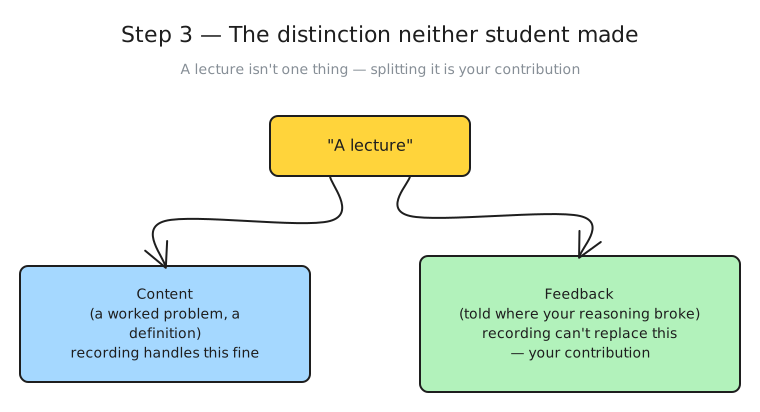
Don’t just assert it — develop it in three beats: name the distinction, ground each half in a concrete instance, then show what follows. Here the two halves are “content” (a definition, a worked problem) and “feedback” (being told where your reasoning broke):
“But a lecture isn’t only content. Watching a worked physics problem is content — a video you can pause handles that fine. Getting told where your own reasoning went wrong is a skill, and a recording can’t do it.”
That’s elaboration: one idea taken down to a specific case, not three ideas listed in a row. The sentence couldn’t be pasted under any other prompt — it only exists as a reply to these posts, which is what a relevant contribution looks like.
Step 4 — Answer the other side, if you have room
This is the most optional move in the set. None of ETS’s three published samples has a standalone rebuttal beat, and the 2026 Score-5 fits its entire concession into one opening clause. Reach for this move when the opposing post makes a point strong enough that ignoring it would look like you missed it.
Two beats: concede something specific and true (not a strawman you can knock over), then answer it with a reason that ties back to your side. Granting a real point first is what makes the answer land instead of sounding stubborn.
“So Daniel’s right that recording is efficient — but only for the content half. Going fully online drops the feedback half too, and that’s the part that matters.”
Notice the concession is exact: recording is efficient for content. So the counter (“but only the content half”) sharpens your position instead of dodging his. You’ve taken a side, added a frame neither student offered, and touched both posts on the way. Only the frame was strictly necessary.
The full response, annotated
Put the four steps together and tighten to about 120 words:
“I’m with Mia: universities shouldn’t move large lecture courses fully online. What you lose isn’t convenience — it’s feedback. Daniel’s right that for pure content — a worked physics problem, a definition — a recording you can pause and rewind is genuinely better, and a 300-person hall was never interactive anyway.
But a lecture isn’t only content. Getting told where your own reasoning went wrong is a different thing, and a video can’t do it. So record the lectures, but keep small live sessions for that feedback. The problem was never ‘online’ — it’s ‘fully.’ Drop the one part a recording can’t replace, and you save money by losing the point.”
Everything the scoring guide rewards is in there:
- A clear position on the actual question — “no, not fully online,” which is what the professor asked, not the wider topic of online learning.
- A perspective the discussion didn’t have — content vs. feedback, the distinction neither student made.
- Elaboration, not a list — the worked physics problem takes one idea down to a concrete case.
- Its own words — nothing lifted from the professor’s post or the students’.
The two classmate references are in there as well: it sides with Mia and answers Daniel. They made the post fast to write. They are not what earns the score, and ETS’s published Score-5 answer has neither — take them out and the four bullets above still stand.
Common mistakes
- Answering the topic instead of the question. ETS’s own Score-4 argued that light bulbs beat candles, not that they were the most important invention in 200 years — which is what the professor asked.
- Filling the template and stopping. “While some argue X, I believe Y. First of all…” with generic reasons. It’s structurally complete and scores low, because there’s no contribution in it.
- Restating a student instead of adding to them. Agreeing with Daniel and repeating his reasons puts nothing new on the board. If you reference him, follow it straight away with something he didn’t say.
- Borrowing the prompt’s language. Lifting phrases from the professor or the posts is the specific thing the scoring guide marks down. Paraphrase in your own words.
- Treating every typo as a lost point. The guide’s top level forgives “common typos or common misspellings or substitutions like there/their.” Accumulating grammar errors do cap a score; a stray there/their doesn’t.
- Chasing length. A 250-word answer in 10 minutes is usually a solid idea plus 100 words of errors. Land in the 120–180 range, then spend your last 2 minutes proofreading.
- Writing a formal essay. This is a discussion post, not an introduction-body-conclusion essay. One clear opinion, developed, in a natural voice beats a five-paragraph skeleton crammed into 120 words.
Practice plan
You can’t learn contribution by reading about it — you learn it by writing posts and seeing where they go generic. A tight routine:
- Take one prompt. Spend 2 minutes finding the seam between the two students before you write a word.
- Draft in 6 minutes, forcing one sentence that could only be a reply to these posts.
- Proofread for 2 minutes — cut borrowed phrasing, trim toward 120–180 words.
- Check the result against all four writing dimensions, not just whether it “reads fine.”
That last step is the one most students skip, because self-scoring an opinion is hard. On Toeflair’s Academic Discussion practice you write a real prompt and get a 1–6 band on all four writing dimensions: task achievement / coherence / lexical resource / grammar. That’s how you find out whether your answer contributed or just filled a shape.
Further reading
- ETS — TOEFL Writing Scoring Guide (PDF) — the six descriptors quoted throughout this post.
- ETS — TOEFL iBT Writing practice sets (PDF) — the vaccines and light-bulb responses, with ETS’s own rater explanations.
- ETS — Inside the TOEFL Test: Writing for an Academic Discussion — the official video transcript, including the “may refer to one of the other student posts” line.
- Magoosh — Academic Discussion complete guide — the prep-guide position quoted above, plus annotated samples across score levels.
- Why memorizing fails the TOEFL interview — the same trap on the Speaking side: canned answers cap your score.
- What changed in the TOEFL 2026 reform — where Academic Discussion and the new email task fit in the redesigned test.