


In short: Since January 21, 2026, the TOEFL iBT runs about 1.5 hours, uses a 1–6 band score aligned with international language standards (CEFR), and has new task types in every section. The total score is the average of the four section bands, not a sum. Section order is now Reading → Listening → Writing → Speaking.
What’s new on the TOEFL?
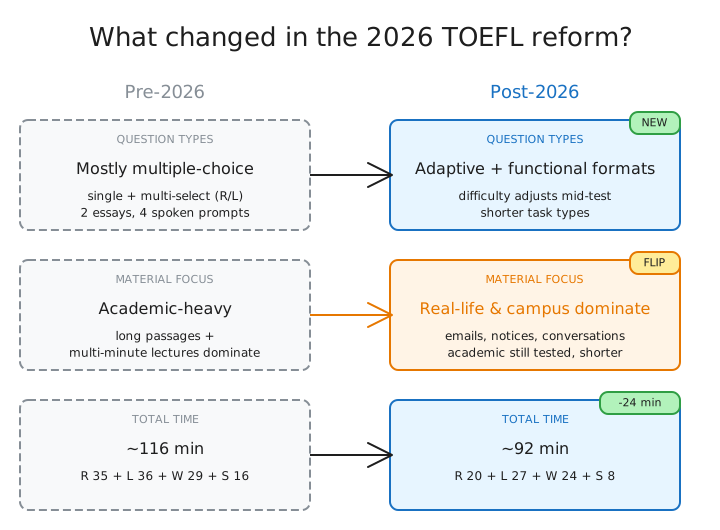
- Adaptive difficulty: Reading and Listening adjust difficulty between stages based on your overall performance — a more accurate read on your real level.
- Shorter test, simpler scoring: The whole test runs about 1.5 hours (down from 2), scored on a 1–6 band aligned with international language standards (CEFR), but still with the 0–120 total alongside.
- New task types in every section: Every section gets shorter and more functional — short emails for real-world issues replace the long academic essay, conversational reply prompts replace long lectures, and so on. Daily-life and campus material now sit alongside academic content.
Reading — adaptive, with free navigation inside each module
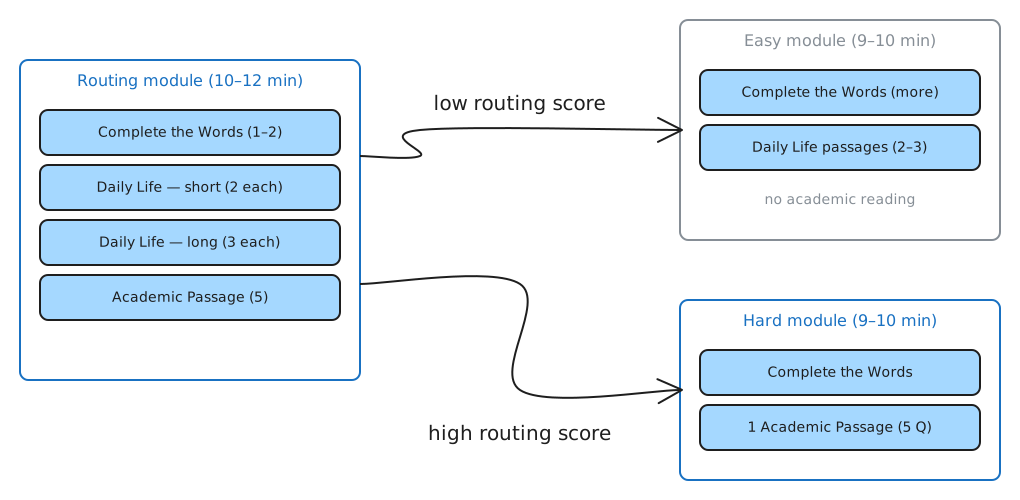
Reading is now built around an adaptive mechanism: the difficulty of the second module shifts based on how you performed on the routing module. About 20 minutes total, with 35–48 items depending on which path you’re routed onto.
Complete the Words
Brand new in 2026. You read a short paragraph (about 70 words) where 10 words have their endings cut off (always somewhere in the second half of each word), and you type the missing letters in. The number of blanks per word is visible. Vocabulary AND spelling tested in a single item, so “kind of knowing” the word isn’t enough.
Here’s a sample of two words in context:
Prompt: “A consistent study routi__ __ helps stude__ __ __ build steady progress over time.”
Answer: “A consistent study routine helps students build steady progress over time.”
Passage-based questions
The remaining Reading items are short passages followed by multiple-choice questions — in two content categories:
| Daily Life | Academic Passage | |
|---|---|---|
| Length | short (40–50 words) or long (100–140 words) | about 200 words |
| Questions | 2–3 questions per passage | 5 questions per passage |
| Content | emails, texts, pamphlets, notices, invoices — anything you’d encounter on or off campus | short excerpts from books, magazines, or websites — academic topics with a modern, relatable angle |
Pre-2026 academic readings ran 600–700 words with 10 questions, so the new format trims academic content significantly.
Easy paths skew toward the high end of the 35–48 range because Complete the Words and daily-life items come in higher counts; Hard paths skew low because one academic passage carries 5 questions on its own.
Inside each module you can navigate freely and change answers, but once the routing module is submitted you can’t go back to it.
Listening — adaptive, single-pass, no replays
Same adaptive shape as Reading: a routing module sets the level, then the second module is harder or easier. About 27 minutes total.
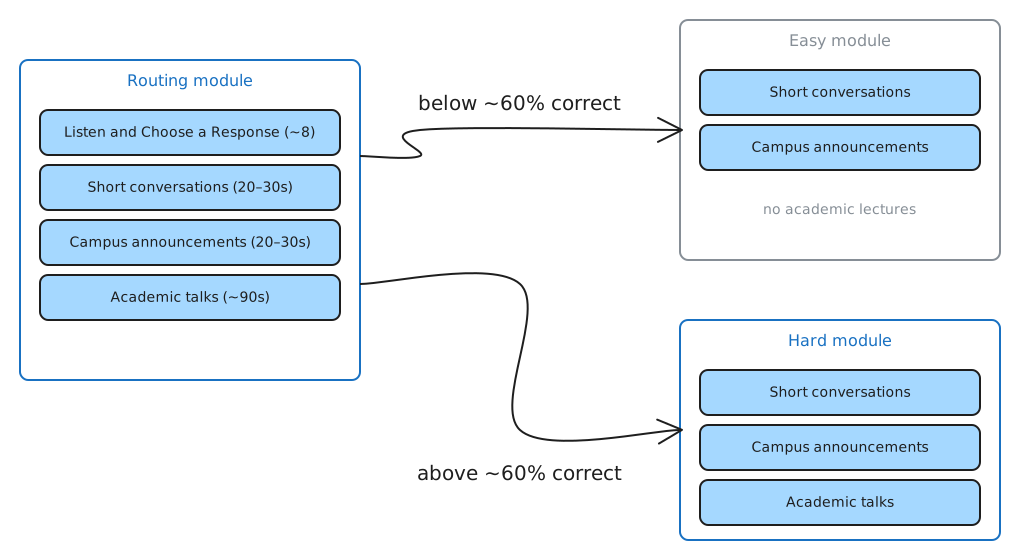
Listen and Choose a Response
New for 2026. You hear a 5-second utterance and pick the most natural reply from four written options. Think of it as a real-time pragmatic-competence test — the prompt might be a question, a complaint, or an invitation, and you choose what a native would actually say back.
Here’s a sample:
Audio: “I can’t believe how cold it is in this lecture hall.”
Options:
(a) Yeah, I should have brought a jacket. ← natural reply
(b) That’s interesting.
(c) I agree with the professor.
(d) Could you repeat that?
Audio-based questions
The remaining Listening items are short audio clips followed by multiple-choice questions — in three categories:
| Conversations | Announcements | Academic talks | |
|---|---|---|---|
| Length | 20–30 seconds | 20–30 seconds | about 90 seconds |
| Questions | 2 per audio | 2 per audio | 5 per audio |
| Format | two speakers (a man and a woman) | single announcer | single lecturer |
| Content | everyday life on or off campus | upcoming campus events, service changes | psychology, sociology, history, economics, art, etc. |
Pre-2026 academic lectures ran 3–5 minutes with replay questions, so the new 90-second talks are a major trim.
Three things make Listening unlike Reading:
- Audio plays only once: No replay button — the old “you’ll hear part of the lecture again” replay questions are gone in 2026.
- You can’t go back to change earlier answers: Once an item is submitted, the section moves on.
- Note-taking is allowed and encouraged: Scratch paper is provided.
An unofficial score appears immediately on completion; the official result follows in about three days.
Writing — three short tasks, no more Integrated essay
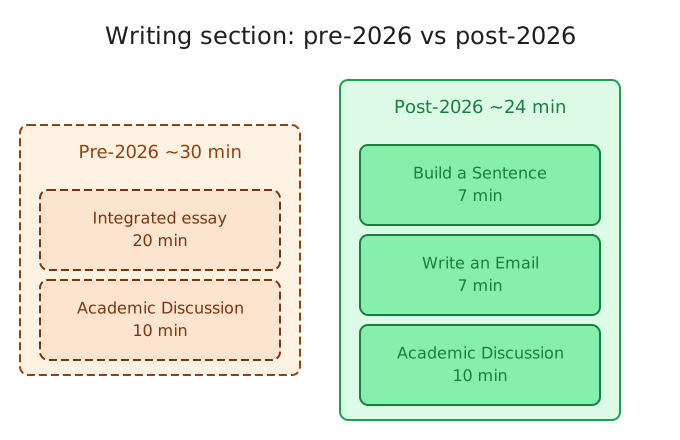
About 24 minutes, 12 items, three task types. The headline change: the 20-minute Integrated essay is gone, replaced by two shorter functional tasks — Build a Sentence and Write an Email. Academic Discussion carries over unchanged.
Build a Sentence
Introduced in 2026. You see a short context sentence and a set of 5–7 jumbled words (sometimes with one extra distractor) — click and drag them into a grammatically correct response that fits the context. 10 items in about 7 minutes — roughly 40 seconds each. Binary scoring: 1 point per perfectly ordered sentence, 0 if any position is off.
Here’s a sample:
Prompt: “What did she ask about your future plans?”
Your response: __ __ __ __ __ __ I’m __
Word bank: considering / she / to / wanted / know / colleges / which
Correct answer: “She wanted to know which colleges I’m considering.”
Write an Email
New in 2026. A functional email response in 130–140 words, 7-minute window. You’re given a short scenario (a roommate request, a professor’s question, a campus inquiry) plus three required elements your reply must address. Tone matters: AI scoring evaluates politeness alongside grammar, vocabulary, cohesion, completeness, and punctuation.
Here’s a sample prompt:
Your roommate emailed asking if their friend can stay in your shared apartment for two weeks. Reply, addressing:
- whether you agree
- any conditions or concerns
- what should happen during the visit
Academic Discussion
Carried over from the pre-reform format. Respond to a professor’s discussion-board question in about 120 words. 10-minute window. Scored on content, grammar, and vocabulary. What caps most scores here is templating instead of contributing — we walk through the fix in a full Academic Discussion guide.
The per-task dimension scores aggregate into the section’s 1–6 band.
Speaking — two task types, no prep, about 8 minutes
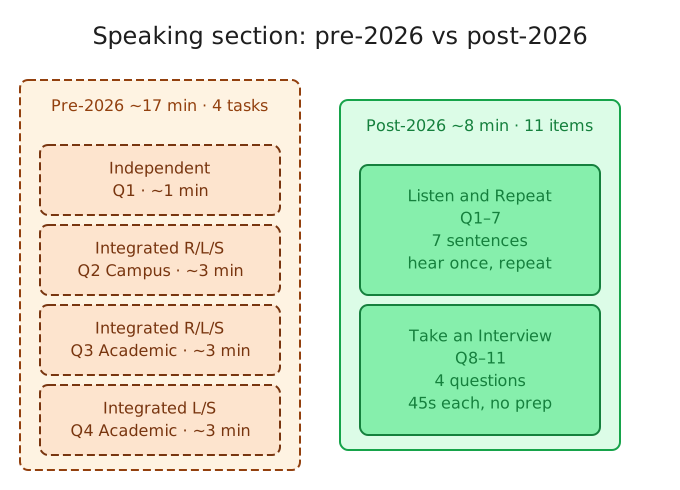
About 8 minutes, 11 items, two task types — Speaking now runs as the final section of the test. The headline change: the old 4-task Independent + Integrated format is gone, replaced by two new task types — Listen and Repeat and Take an Interview — with no prep time anywhere.
Listen and Repeat (Q1–7)
Brand new in 2026. 7 sentences of increasing difficulty. You hear each once, then repeat after a brief pause and beep. No prep time, no second listen.
Here’s how an early and a late item might compare:
Early item: “The library closes at 9 tonight.”
Late item: “International students must complete the online application by Friday.”
Take an Interview (Q8–11)
New for 2026. 4 questions from a simulated interviewer on everyday topics — hobbies, school life, opinions on common situations. 45 seconds per response, no preparation. Audio only — the questions aren’t shown on screen.
Here are some sample prompts:
“What’s a hobby you enjoy and why?”
“Describe a memorable trip you’ve taken.”
“Do you prefer studying alone or in groups?”
Each task type has its own rubric. Listen and Repeat is graded primarily on whether you reproduced the prompt correctly and intelligibly; Take an Interview adds fluency, coherence, grammar/vocabulary, and intonation. An AI engine does the first-pass grading — we tested how accurate that is on 674 attempts.
If you’re picking a tool to practise against that engine, we also ranked the TOEFL AI feedback tools by how deep their feedback goes.
What the new scoring looks like
The biggest source of confusion: your total score is the average of the four section bands, rounded to the nearest half point — not a sum and not the old 0–120 scale. A clean 5.0 across all four sections is a 5.0 overall. Drop one section to a 4.0 and the average pulls down to a 4.75.
The 1–6 band aligns with CEFR: roughly 6 = C2, 5–5.5 = C1, 4–4.5 = B2, 3–3.5 = B1. That’s the angle admissions teams are already using to compare TOEFL to IELTS and Duolingo without conversion tables. On that scale, what counts as a good Speaking score starts at 4.0 — the minimum most universities accept — which we mapped across 600+ graded practices. The band-by-band conversion for every section is on the TOEFL score chart.
There is no single band-to-old-score table: ETS publishes a separate conversion for each section, so a 3.0 is 16–17 in Speaking but 6–11 in Reading. Look up your own section on the TOEFL score chart; the CEFR level is the part that holds across all four, which is why admissions teams anchor on it.
Score reports issued during the two-year transition (through January 2028) print the new 1–6 band, the CEFR level, and the legacy 0–120 score side by side, so admissions teams can re-anchor their cutoffs. After the transition, only the 1–6 band remains.
Two smaller wins worth knowing: scores now turn around in 72 hours or less (down from 6–10 days), and the Home Edition is still available with no policy change in availability.
Further reading
- ETS — TOEFL iBT format and scoring — ets.org/toefl/test-takers/ibt/about.html (official source on the 2026 structure and 1–6 band).
- TOEFL Resources — toeflresources.com (independent section-by-section walkthrough with sample items for Reading, Listening, Writing, and Speaking).
- Council of Europe — CEFR level descriptors — coe.int/en/web/common-european-framework-reference-languages (reference framework the 1–6 band maps onto).