


Before we get to the TOEFL interview, let me tell the story from the other side of the table — from the interviewer who has to sit across from you and actually listen.
Suppose you’re hiring for one open seat on your team, and a thirty-minute conversation is all you get to decide. You ask the candidate across the table one question — and they answer:
You ask
The role is customer-facing — calming an angry customer is the job, not the exception. So you ask the one question that actually predicts whether they can:
"Tell me about a time you turned around an unhappy customer."
They answer
"I always stay calm and listen carefully to the customer's needs, and I find a solution that works for everyone — because communication is the key to resolving any conflict."
They start talking the instant you finish — too fast. Smooth, fluent, and completely hollow. There’s no real customer in it, no specific afternoon, no thing that actually went wrong; it’s a paragraph they wrote at home and have recited forty times. The logic doesn’t hold up, and the moment you reach for a detail, there’s nothing there.
Do you hire them?
You don’t. And here’s the part that matters for your TOEFL score: the AI scoring your Take an Interview answers is listening for exactly the same thing you just rejected — a real shape, solid logic, details that hold up, not a script recited under pressure.
You can’t memorize your way through the TOEFL interview. The prompts are too unpredictable for a stored answer to fit. What transfers from one prompt to the next is structure — and structure is what you drill.
What to build instead: structure, not scripts
The instinct, when speaking is hard, is to memorize more — bank a few strong answers and hope the question is close enough. The interview is built to defeat exactly that. Four questions, no prep time, topics that swing from your last vacation to whether companies should fund virtual team-building. A memorized answer to one prompt is dead weight on the next.
So stop banking answers. Bank the three things that actually carry across prompts:
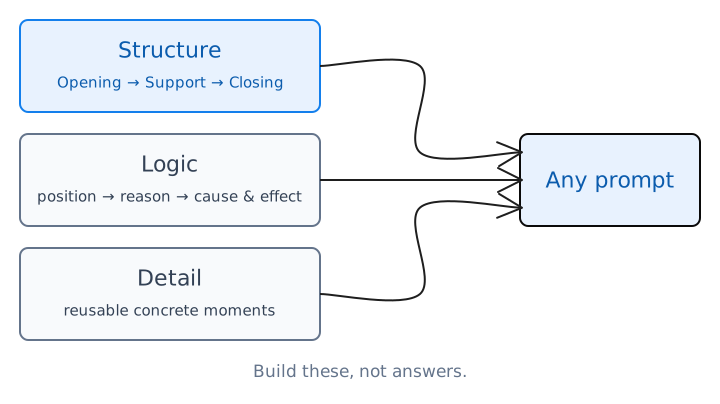
- Structure — a fixed answer shape you can drop any content into: Opening → Support → Closing. It never changes, so it costs you nothing to retrieve live.
- Logic — the reasoning path through that shape: a position, a reason, a concrete cause and effect. The logic adapts to the prompt; the shape doesn’t.
- Detail — a small stock of real, specific moments you can reach for. Not a memorized answer — a reusable image you adapt on the spot.
The AI grades three matching dimensions, and it’s worth knowing what each one is actually measuring before you drill against it:
Dimension | What it measures |
|---|---|
| Delivery | How you sound — pace, fluency, pauses, filler words. Smooth and clear, or hesitant and broken up. |
| Language use | Grammar and vocabulary — tense control, sentence variety, precise words over vague ones. |
| Topic development | How far you take the idea — whether you support a claim with a specific detail, or just restate it. |
Notice that none of these reward a memorized paragraph. Delivery exposes a recited script the moment the rhythm sounds rehearsed. Topic development punishes the restated claim with no real detail. The three building blocks above map straight onto the three things the scorer is grading — which is why drilling structure beats drilling scripts.
Step 1 — Give every answer the same skeleton
Every interview answer fits one shape:
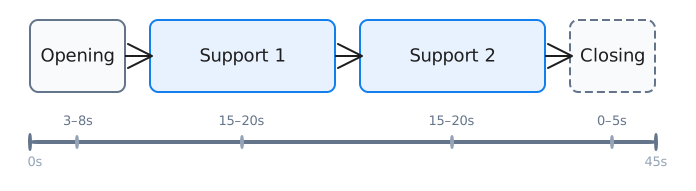
Opening (3–8s) → Support (15–20s each) → Closing (0–5s, optional). Finish inside 45 seconds.
The shape is fixed. What changes per question type is only what goes inside each Support. Here’s the same skeleton across the four question types you’ll meet:
Question type | Opening | Support holds… | Closing |
|---|---|---|---|
Opinion / preference | State your position | argument + a concrete example | restate position |
Recommendation | Name your suggestion | the measure + its effect + who benefits | the value of doing it |
Pros & cons | Name your angle | argument + a concrete case | which side you lean |
Experience | Set the scene (who / when / where) | what happened — the steps and the turn | the result or how you felt |
Take one prompt and build it out:
Prompt: “Some people learn better studying alone; others prefer studying in groups. Which do you prefer?”
Opening: “I prefer studying in a group, mainly because explaining things out loud shows me what I don’t actually understand.”
Support: “Last term I joined a small group before our statistics final. When I tried to explain regression to a classmate, I completely froze halfway — and that was the moment I realized I’d been memorizing the formula without understanding it. The group caught a gap I’d never have caught alone.”
Closing: “So for me, groups aren’t about company. They’re a way to find the holes in my own thinking before the exam does.”
That’s the whole skeleton. Opening states the position in one breath. The Support carries one argument — groups expose what you don’t understand — and pays it off with a specific moment, not a slogan. The Closing lands the point.
One full Support beats two thin ones. You don’t need two arguments if one is genuinely developed. A single Support with a real example and a clear cause and effect scores higher than two points that each just restate the claim in new words. Depth is what topic development rewards; breadth is what students reach for when they’re nervous.
And the killer on the experience question: it has to be one specific event, in the past tense. “I usually study with friends and we help each other” is a habit, not a story — and a habit answer caps your topic-development score no matter how clean your English is. The scorer wants last Tuesday, not usually. The hollow candidate from the opening failed on exactly this: “I always stay calm” is a habit; the job — and the question — wanted one real afternoon.
Step 2 — Drill one question into many
Here’s the move that turns one practice question into five. Don’t build a single answer and move on. Take one prompt and build two or three different logic paths through the same skeleton.
Same study-group prompt, three ways in:
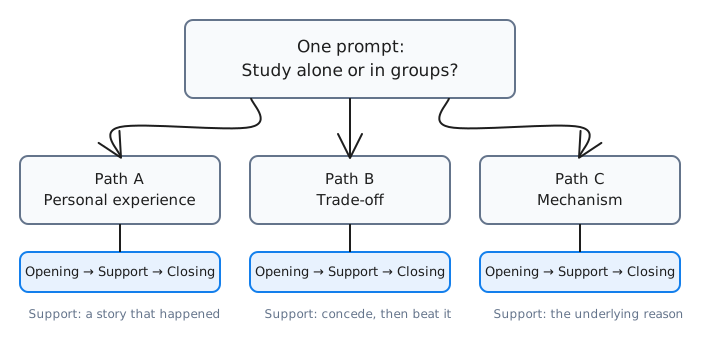
- Path A — personal experience: “I prefer groups.” Support = the statistics-final story above. The logic is this happened to me, so I know it works.
- Path B — trade-off: “I prefer studying alone, even though groups sound more productive.” Support = groups drift into chatting and you cover half the material; alone, I finish in an hour what a group spreads over three. The logic is concede the appeal, then beat it.
- Path C — mechanism: “I prefer groups.” Support = explaining a concept out loud forces you to convert vague recognition into real words — and the gaps show up instantly. The logic is here’s the underlying reason it works.
Three answers, one skeleton, three completely different reasoning paths. Build them and you’ve internalized something a single memorized answer can never give you: the feel of moving from a position to a reason to a detail, fast, no matter which way you go. That’s the muscle the interview actually tests.
This is the engine behind Toeflair’s interview report. When it generates a perfect answer, it doesn’t hand you one model response — it gives you Approach A, B, and C for the same question, each with its own logic flow mapped out. One question, several paths. You practice the move, not the script.
Step 3 — Stock details you can move between prompts
The third building block is the one students skip, and it’s where transfer actually happens. You don’t stock answers. You stock details — small, concrete, real moments — and learn to move one detail across totally different prompts.
The statistics-group story isn’t a study-question answer. It’s a reusable asset. Watch it migrate:
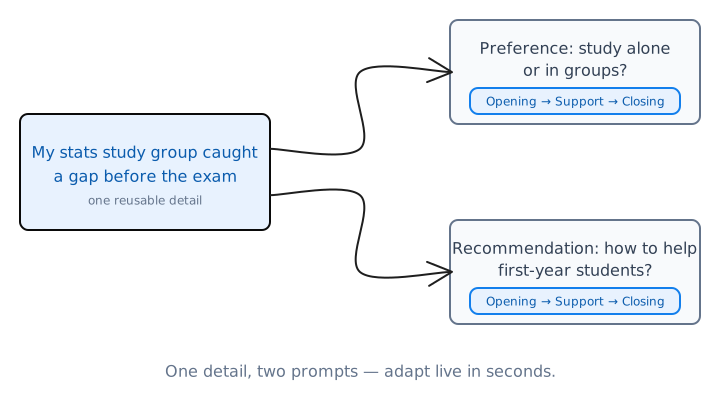
Prompt 1 (preference): “Do you prefer studying alone or in groups?”
The detail, used directly: “Last term my study group caught a gap in my understanding right before the stats final — explaining it out loud is what exposed it.”
Prompt 2 (recommendation): “What should universities do to help first-year students adjust?”
The same detail, re-aimed: “Universities should set up small peer study groups. In my first year, my own group caught a gap in my understanding right before an exam — first-years rarely know what they don’t know yet, and a group surfaces it fast.”
Same moment. Two unrelated prompts. The only thing you changed live was the logic connecting the detail to the question — a few seconds of adjustment, not a new answer from scratch. Build a stock of six or seven of these — a study moment, a work moment, a travel moment, a failure, a small win — and most prompts become “which of my details fits, and how do I aim it?”
That question you can answer in the three seconds the interview gives you. “What do I say?” from a blank page, you can’t.
Step 4 — Drill until the skeleton disappears
The reason any of this matters is the no-prep-time clock. You have a few seconds between hearing the question and speaking, and everything you spend deciding how to structure this is attention stolen from speaking clearly.
So make the structure automatic. When Opening → Support → Closing is muscle memory, retrieving it costs nothing, and the freed-up attention goes straight into delivery. This is the quiet reason structured practice fixes fluency: fluency under pressure isn’t talking faster, it’s having spare attention. You only have spare attention when the shape is already a reflex.
Drill it the boring way. Same skeleton, fresh prompt, every rep, until you stop thinking about the shape at all and only think about the content.
Common mistakes
- Memorizing whole answers. It fits one prompt, breaks on the next, and sounds rehearsed even when it fits — and “rehearsed” is exactly what delivery scoring docks. Memorize the shape, not the words.
- Building one answer per practice question. You’re leaving most of the value on the table. One prompt is worth three logic paths; take all three (Step 2).
- Stockpiling facts with no structure. A pile of details you can’t deploy is useless under the clock. Details only help once they ride on a skeleton you don’t have to think about.
- Over-templating. Rigid memorized phrases (“There are two main reasons why…”) read as robotic to an automated scorer. Structure is a shape, not a script — keep the shape, let the words come live.
- Answering the narrative question with a habit. “I usually…” is the single most common way to cap your own score. One event, past tense, every time.
A practice routine that fits structure, not scripts
- Pick one prompt a day. Any type. Run it through Opening → Support → Closing once, out loud, inside 45 seconds.
- Then run it twice more — different logic each time. Personal experience, trade-off, mechanism. Same skeleton, new path.
- After, bank the detail. Whatever real moment you reached for, write it on your list of reusable specifics. Next week, force it onto an unrelated prompt.
- Once a week, record and count fillers. Replace every “you know” and “uh” with a half-second of silence. It’s the fastest delivery gain there is.
Ten minutes a day. Inside a few weeks the skeleton goes quiet, your detail list gets long enough that most prompts have a match, and the thing that used to feel like improvising from nothing starts to feel like aiming something you already have.
The hollow candidate lost because they brought a script to a conversation. Don’t walk into the interview with answers. Walk in with structure, a few ways to reason, and a pocketful of real moments — and adjust live. That’s the one thing no prompt can catch you out on.
Further reading
- What’s a good TOEFL Speaking score? 600+ attempts, analyzed — the data behind why interview scores stall: the ceiling is detail and execution, not ideas.
- ETS — About the TOEFL iBT Speaking section — ets.org/toefl/test-takers/ibt/about (official task format and timing).
- ETS — Understand your TOEFL iBT scores — ets.org/toefl/test-takers/ibt/scores/understand-scores.html (the 1–6 band and what each level means).