


You can write a TOEFL email with zero grammar mistakes and still score a 3.5. Clean grammar is the entry ticket, not the score — by the time you’re scoring band 4, the grader already assumes it.
Three other things decide whether your email moves up: how specific your content is, how clearly it’s organized, and whether your tone fits the reader. This guide walks each one through a real prompt, so you know where to actually spend your seven minutes.
The rule: clearing grammar only gets you to band 4. Going higher is decided by what you say, how you order it, and who you say it to.
What “Write an Email” actually asks for
You read a short scenario, then reply to it in one email. The prompt always lists the points your reply has to cover.
| Element | Detail |
|---|---|
| Time | 7 minutes — read, plan, write, quick check |
| Word count | About 80–120 words |
| On screen | A scenario + the points your reply must address |
| Your job | Reply with a greeting, a short body, and a closing |
| Score | Part of your Writing section, reported on ETS’s 1–6 band (2026) |
That 1–6 band is one holistic judgment, and grammar is only one piece of it. A grader weighs four things at once:
| What the grader weighs | What it means for your email |
|---|---|
| Purposeful communication | You cover every required point — with specifics, not just a mention |
| Organization | The reply flows: greeting, a clear body, a close |
| Tone & conventions | Your register fits the recipient (formal to a professor) |
| Language accuracy | Grammar and vocabulary are correct |
Notice that grammar — “language accuracy” — is one row out of four. The other three are where most students leave their points on the table.
Why error-free grammar won’t raise your band
Here’s a real TOEFL email prompt from our practice bank. Keep your eye on it — every step below builds on this same example.
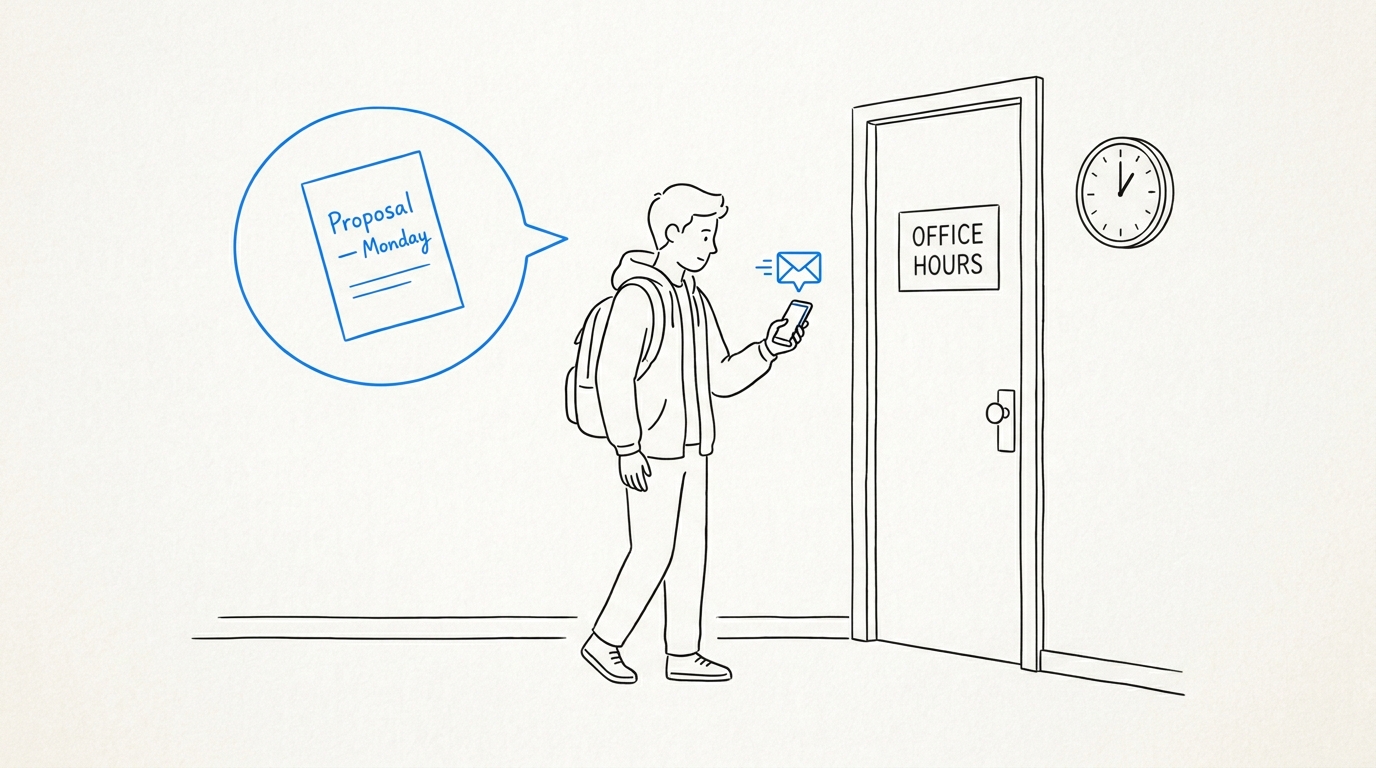
You’re an undergraduate at Greenfield University. You missed your biology professor’s office hours yesterday — your previous class ran late because of an exam — and your topic proposal is due Monday. Write an email to your professor, Dr. Nakamura, that:
- apologizes and explains that your previous class ran late due to an exam
- asks whether she has time this week to meet about your paper
- mentions two topics you’re considering and asks which is more suitable
Now read a draft a student might dash off in seven minutes. The grammar is clean — no real errors. Read it the way a grader would:
Hi Professor,
Sorry I couldn’t make it to your office hours yesterday. Can we meet sometime this week? I really need to talk about my research paper before the proposal is due.
I missed it because my last class ran late after an exam. I have a few ideas for my topic but I’m not totally sure which one to go with, so I’d love some help.
Thanks a lot! Hope to hear back soon.
Wei
Not one grammar mistake. And it still lands around a 4 — because the three things that actually raise a band are all a little off.
The tone misreads the relationship — a casual “Hi Professor” on the surface, and underneath, an ask that hands the professor the decision (“I’d love some help”) instead of showing a position for her to react to. The order makes the reader work — the request comes before the reason it’s needed. And the content point that decides the task — which two topics — never arrives.
Clean grammar got this email to a 4. The next three sections are how it gets to a 5 or 6.
The three things that actually raise your band
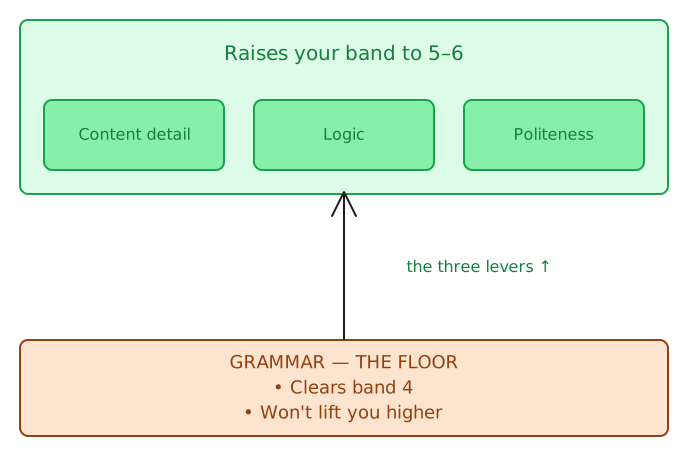
1. Content detail — answer each point with something specific
A required point isn’t answered when you mention it. It’s answered when you say something only you could say.
The draft says “a few ideas for my topic but I’m not totally sure which one to go with” — generic enough to fit any paper, in any course. Name the actual topics:
I have a few ideas for my topic but I'm not totally sure which one to go with.
I have been considering two topics — the impact of microplastics on local river ecosystems, or the development of genetic resistance in urban pest populations — and would value your feedback on which is more suitable.
The specific version is barely longer and no more grammatical — it just gives the professor something real to react to. Specific content is the single biggest lever on this task.
2. Logic — put one idea per sentence, in the order the reader needs it
A short email still has a shape: apologize and explain, then make your request, then the specifics that support it. The draft runs backwards — it opens with “Can we meet this week?” and only says why it missed the meeting a sentence later.
Can we meet sometime this week? … I missed it because my last class ran late after an exam.
I'm sorry I missed your office hours — my last class ran late after an exam. Could we meet sometime this week?
The first makes the professor work backward to piece together what happened; the second gives the reason, then the request that follows from it. Read your draft as the professor — if two sentences could swap places without anything breaking, they’re not yet doing logical work.
3. Politeness — show a position, don’t offload the choice
A formal greeting and sign-off are the threshold: “Dear Dr. Nakamura” over “Hi Professor” gets you in the door, and no further. Real register is in how you ask — and the trap, especially in a second language, is overshooting into deference. Handing the professor your decision to make isn’t humble; it’s an imposition wearing humility’s clothes. The polite-and-direct move is to show the thinking you’ve already done, then invite her to react.
Could you just tell me which topic is better? I really don't know which one to pick.
I'm leaning toward the microplastics topic for its local relevance — would you agree it's the stronger fit, or steer me to the other?
Both are perfectly grammatical. The first hands the professor your homework; the second shows a position and asks her to confirm or redirect it — far less to impose on, and the register a grader rewards. “Tone and conventions” scores fit: offloading the decision misses it as much as bluntness does, and clean grammar recovers neither.
The same email, with all three levers
Here’s a strong answer to this exact prompt — the model response our AI generates for it:
Dear Dr. Nakamura,
Please accept my sincere apologies for missing our appointment during your office hours yesterday. My previous chemistry class ran significantly over time because our mid-term exam took longer than anticipated, and I could not leave until all papers were collected.
As the topic proposal deadline is next Monday, would it be possible to reschedule for later this week? I am available Thursday afternoon or Friday morning. I have been considering two potential topics: the impact of microplastics on local river ecosystems, or the development of genetic resistance in urban pest populations. I would greatly appreciate your feedback on which might be more suitable.
Thank you for your time and understanding.
Best regards,
Alex
Same register, same clean grammar as the first draft. The band is higher because the reason is specific, the request is concrete, and the third point — two named topics with a real question about them — is fully delivered.
Common mistakes
- Treating grammar as the goal. It’s the floor. Clear it once, then spend your remaining minutes on content, order, and tone.
- Vague requests. “I’d like some guidance” tells the professor nothing. Name exactly what you’re asking about.
- Skipping a required point. The prompt’s points are a checklist. Miss one and purposeful communication drops, however clean the prose.
- Confusing polite with appropriate. Adding “please” doesn’t fix a too-casual greeting to a professor. Match the register to who’s reading it.
A 7-minute practice loop
Pick one prompt and run the clock: 1 minute to read and plan, 5 to write 80–120 words, 1 to check. But don’t spend that last minute on commas. Check the three levers instead — did you cover every point with something specific, does each sentence follow the last, and does the tone fit the reader? That’s the check that moves your band.
Then do it again with feedback. Practice a real Email task on Toeflair and see your 1–6 band across all four dimensions, so you can tell which lever to pull next.