

SpeechRater is ETS’s own automated engine for scoring TOEFL Speaking. It wasn’t borrowed from the GRE or any other ETS exam. It was built specifically for spoken English, and it’s been running since 2006. Since the January 2026 reform, it’s the first thing every Speaking response goes through.
Where it came from
ETS didn’t build SpeechRater for the TOEFL first. It was developed for spoken-English assessment generally, then deployed in 2006 on TOEFL Practice Online, a low-stakes companion test. That was years before it touched a real TOEFL score.
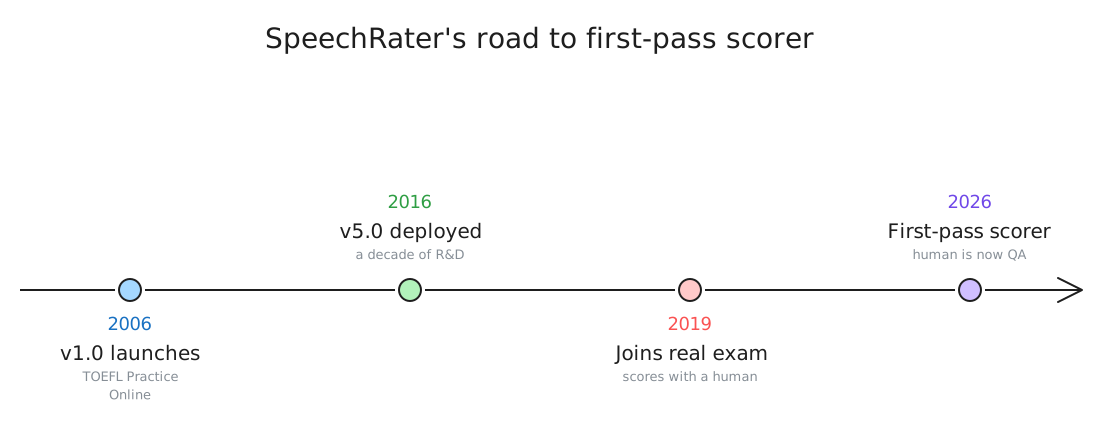
ETS’s published research documents v1.0 and v5.0 by name. What changed in between isn’t detailed in public materials, so treat those two as the confirmed anchors, not a complete version history.
What it actually measures
The engine runs speech recognition on your response. It then extracts features (ETS groups them into six classes: pronunciation, prosody, vocabulary, grammar, content, discourse). Those six roll up into the three dimensions your score actually reports.
| Dimension | Feature class | What it captures |
|---|---|---|
| Delivery | Pronunciation | Clarity of individual sounds |
| Prosody | Rhythm, intonation, pace and pauses | |
| Language Use | Vocabulary | Range and precision of word choice |
| Grammar | Accuracy of grammatical structures | |
| Topic Development | Content | Whether the idea is relevant and specific |
| Discourse | How well the idea is organized and developed |
The six-class breakdown is a step more concrete than the “100+ features” line on ETS’s own marketing page. It’s the same engine, just described at the level ETS’s research reports actually use.
One real answer, read the SpeechRater way
Take a real example. A Toeflair user got this interview question: “Could you describe a conflict or misunderstanding that arose from relying on digital communication, and explain how you attempted to resolve it?” Here’s what they said, in full:
The response: “That’s a really, that’s a really great question. I think there are many challenges that come along with digital communication, such as many typos happening. Once in my college education, I was communicating with a professor about an assignment deadline, and because I had messaged a typo, he had understood my response in a way that was incorrect, and so that led to a little bit of disagreement in terms of how I, how seriously I treat the class, and it gave him the wrong impression, ultimately, of how I am as a student because of my typo.”
Notice what’s missing. The question asked how the conflict was resolved, and the answer never gets there. It describes the misunderstanding in detail, then stops.
Our engine reads the same dimensions ETS does. Here’s how it scored this response:
| Dimension | Score |
|---|---|
| Delivery | 4.5 / 6 |
| Language Use | 4.5 / 6 |
| Topic Development | 3.5 / 6 |
The dimension split is the whole point. A single number would have hidden what actually happened: the delivery and language control were strong, but the missing resolution shows up exactly where it should — as a Topic Development gap, not a speaking-skill gap. Only a dimension-level read makes that visible.
SpeechRater isn’t e-rater
The two get paired a lot, but they’re not the same system. SpeechRater scores Speaking. It reads audio. e-rater scores Writing, a separate ETS engine that reads a typed response instead (grammar, usage, mechanics, style, vocabulary, organization).
Some guides describe e-rater as getting the identical “first-pass, human-reviews-flagged-ones-only” treatment SpeechRater got in the 2026 reform. ETS’s own e-rater documentation doesn’t confirm that specific change for Writing, so we’re not asserting it here. What’s confirmed: they’re two different engines for two different skills, not one system doing double duty.
Where accuracy fits in
Knowing what SpeechRater measures is one question. Whether it measures it accurately is another. We broke that down separately, dimension by dimension, across 674 graded attempts, in how AI grades TOEFL Speaking.
For the full shape of the 2026 reform SpeechRater’s first-pass role is part of, see everything that changed in the 2026 TOEFL.
Further reading
- SpeechRater Service — ETS’s official page for its automated speech-scoring engine
- ETS Research Report RR-18-10 — “Automated Scoring of Nonnative Speech Using the SpeechRater v.5.0 Engine,” source for the six feature classes
- e-rater — About — ETS’s official page for its automated Writing-scoring engine
- How AI grades TOEFL Speaking: 674 attempts — accuracy, dimension data, and where a grader should add on top
- Everything that changed in the 2026 TOEFL — the reform that made automated scoring the first pass