


You’ve written a dozen TOEFL emails and academic discussion posts. The word count looks right, the structure holds, and your band hasn’t moved. That’s not an effort problem. It’s a measurement problem.
Writing more responses builds volume. It doesn’t build skill unless something after each attempt tells you exactly what went wrong. Most students never get that. They get a single number, or nothing, and repeat the same habits response after response.
This piece breaks down what the 2026 TOEFL writing rubric actually scores, why drilling prompts alone stalls out, and a practice loop that uses feedback instead of ignoring it.
Why More Prompts Don’t Equal a Higher Score
Finishing a practice email with no scoring feels productive. It isn’t, if nothing tells you what to change.
Read your own response back and decide it “sounds okay.” You still don’t know whether you missed part of the prompt, your organization broke down in paragraph two, or your word choice is stuck at the same level it was three weeks ago. Without a breakdown, you’re practicing blind, and you might be reinforcing the exact habit that’s costing you points.
A 4 on one thing and a 2 on another sets a completely different priority than two 3s. Treating “my writing” as one thing to generally improve misses that a writing score comes from several separate judgments stacked together, not one.
What the Tasks You’ll Practice Actually Test
The January 2026 reform changed the TOEFL Writing section to three task types: Build a Sentence, Write an Email, and Academic Discussion. Build a Sentence and Write an Email replaced the old 20-minute Integrated essay; Academic Discussion carries over from before the reform, unchanged.
TOEFLAIR covers two of those three — Email Writing and Academic Discussion:
| Task | Time | Word count | What’s on screen |
|---|---|---|---|
| Write an Email | 7 minutes | About 80–120 words | A scenario + a list of points your reply must address |
| Academic Discussion | 10 minutes | At least 100 words (120–180 typical) | A professor’s question + two students’ replies you respond to |
Both are graded holistically by ETS on the official 1–6 band for 2026, in 0.5-point steps: one overall judgment of the response, not four separately published scores. If your prep material predates January 2026, you may be practicing a task that no longer exists, against a scale that no longer applies.
The Four Things Behind Every Writing Score
ETS grades each response with one holistic call. But the official scoring guide already names what’s inside that score: elaboration, clarity, word choice and grammar. TOEFLAIR’s feedback pulls those apart into four things you can actually act on:
| What it checks | What it means |
|---|---|
| Content & Coverage | Did you fully address every part of the prompt, and develop it with real detail? |
| Coherence | Does your writing flow logically? Are ideas connected clearly? |
| Language Use | Is your vocabulary accurate, precise, and pitched to the right register? |
| Grammar | Is your grammar accurate and varied? Do errors interfere with meaning? |
Knowing what each one checks changes what you look for after you finish a response. The question isn’t “was that good?” It’s: which of these four is holding your band down?
A student who writes clean, grammatical sentences but stays on the surface of the prompt is losing points on Content & Coverage, not Grammar. A student with real ideas who jumps between them with no clear connectors is losing points on Coherence. Those are different fixes, and “study more” doesn’t tell you which one to make.
The Mistake That Keeps Scores Flat
Here’s a pattern that stalls a lot of students: you decide your vocabulary “isn’t good enough,” study word lists, and write more prompts. Nothing moves, because the actual problem usually isn’t vocabulary range. It’s using words you already know in the wrong register.
“I would appreciate it if you could kindly enlighten me regarding the aforementioned matter.”
That sentence has range — “enlighten,” “aforementioned” — but it’s stiff for an email to a professor about missing office hours. The fix a student needs here isn’t more words. It’s matching register to the reader, which shows up under language use as a word-choice problem, not a limited-range one.
General vocabulary study doesn’t fix a register problem. Feedback that names the sentence and the dimension does.
Our own submission data backs this up from the other side: two Email Writing responses on file scored a flat 6.0 across all four dimensions, and neither reaches for an uncommon word. One is a same-day noise complaint asking a building manager to “send the resident a formal reminder about the building’s quiet-hour policy.” The other apologizes for a missed office-hours meeting and asks, “Would you be available at any point this week for a 15–20 minute meeting?” Ordinary words, used precisely.
What earned the 6 in both cases was structure, not vocabulary. Each response states its purpose in the first two sentences. Each names one concrete problem instead of a vague one — a day, a time, what was already tried. Each ends with a request the reader can actually act on.
A Practice Loop That Uses Feedback Instead of Ignoring It
A framework you can run regardless of which tool you use:
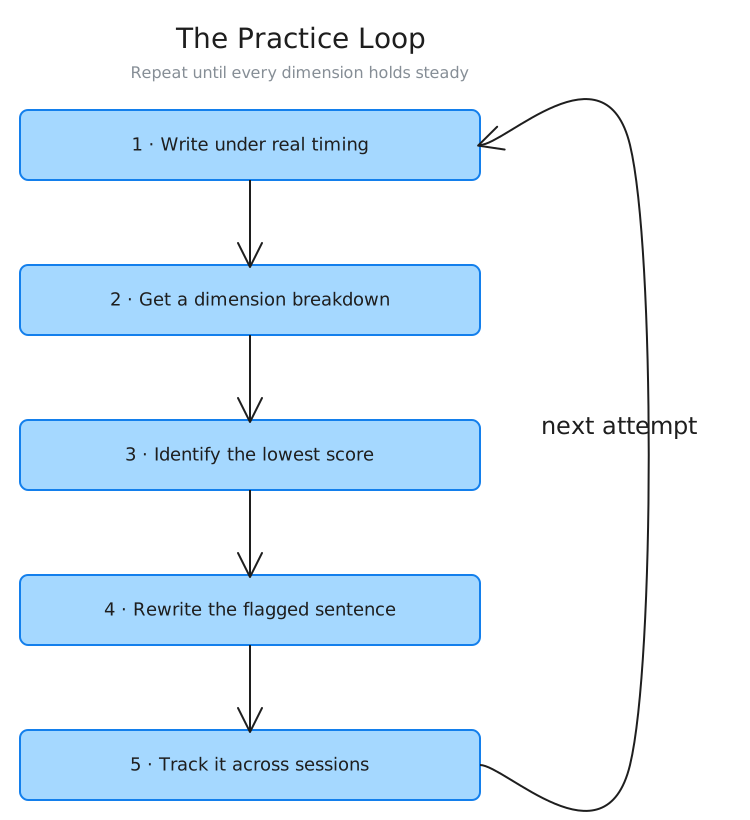
Step 1 — Write under real timing. 7 minutes for an email, 10 for academic discussion. Don’t edit mid-sentence. Comfort with the clock is its own skill.
Step 2 — Get a dimension breakdown, not just a total. The overall band tells you where you are. The four dimension scores tell you why — and which one to act on next.
Step 3 — Identify the lowest score. If Content & Coverage is a 3 and everything else is a 4, that’s this week’s target. Don’t spend the next session polishing Grammar.
Step 4 — Go back to the flagged sentence. Good feedback names the exact sentence or paragraph behind the low score. Reread it, rewrite it by hand, and check whether the fix actually addresses that dimension — not just whether it “sounds better.”
Step 5 — Track it across sessions. One low score is noise. The same dimension flagging low three sessions running is a pattern worth attacking directly, not something to wait out.
Academic Discussion Deserves Its Own Attention
Academic Discussion is the task most students underestimate. It looks informal since it’s a “discussion,” but it’s judged on the same things as any other writing task. A short response, or one that agrees with a classmate without adding a real point, scores low on content coverage no matter how clean the grammar is.
The trap here is template reliance: a memorized opening and closing wrapped around whatever content happens to fit. The structure looks right. The score doesn’t reflect that, because the content inside is thin.
For what actually moves the needle on this task, see our piece on TOEFL Academic Discussion: beyond the template trap.
The Email Task Is More Nuanced Than It Looks
Write an Email tests whether you can write purposefully in a formal register — a clear purpose stated early, the right tone, and a reply that actually does what the scenario asks.
Grammar matters, but it’s rarely the main issue. Most students scoring below a 4 on the email task are losing points on content coverage: a polite, grammatically clean email that doesn’t fully address what the scenario described.
For a full breakdown of what raises the band on this task, see TOEFL email writing: grammar isn’t what raises your band.
What Useful Feedback Actually Looks Like
Useful feedback names what it affected, points to the exact sentence where the issue showed up, and says what the problem was — not just that a problem exists.
“Your vocabulary could be stronger” tells you nothing. “Your language use was affected by ‘enlighten’ and ‘aforementioned’ in paragraph one — accurate words, wrong register for this email” tells you exactly what to fix and where.
TOEFLAIR scores both Email Writing and Academic Discussion against the official 2026 ETS 1–6 band, and every issue it flags is pinned to the exact sentence and what it affected, not a general impression of the response. You also get a perfect-answer sample for the same prompt, so you can see what a stronger response actually looks like on your own scenario.
The free plan gives you 5–6 practice sets per practice type with full AI feedback, no credit card required: enough to see what dimension-pinned feedback looks like on your own writing before you commit to anything.
A Note on the Speaking Side
If your writing practice is going well but your overall score is still short of target, the speaking tasks may be the gap. The same principle holds: drilling responses without knowing which dimension is flagged produces volume, not progress.
Listen and Repeat, for example, is scored on more than pronunciation — and it’s the one task on TOEFLAIR where you can already repractice the exact flagged issue and compare your before and after. See why 10 reps of Listen & Repeat fix nothing if that’s the section holding your total score down.
The Real Goal of Writing Practice
Drilling prompts isn’t wrong. It’s incomplete. Volume only helps when each attempt tells you something specific to fix next.
The 2026 writing tasks are still new, and a lot of prep material hasn’t caught up. If your feedback doesn’t tell you what’s weak beyond one number, you’re not preparing for the task you’re about to sit.
Start with one response. Get feedback that names the sentence and what it cost you. Find out which of the four is actually holding your score back. Then fix that, specifically, before you write the next one.