


In short: Listen & Repeat 2.0 turns a single band into a fix list. Each sentence is split into individual issues, each issue is labeled with its cause — Listening, Pronunciation, or Expression — and you can retry one sentence in place until the problem reads FIXED. This is a walkthrough of the whole loop, screen by screen.
The old Listen & Repeat report gave you a number and left you to guess. You’d score a 3.5, feel it was low, and re-record the whole set hoping the number moved. It usually didn’t, because a repeated attempt doesn’t know what went wrong.
The rebuilt report starts from a different question. Not “how good was that?” but “which part of the chain from ear to mouth broke, on which sentence, and by how much?” Below is how to use it, from picking a set to watching a mistake turn to FIXED.
What’s new in 2.0
Three things changed, and they compound:
- Per-sentence, per-issue breakdown. Each of the 7 sentences is scored on its own 1–6 band, and inside each sentence every mistake is a separate issue with its own coaching.
- A cause on every issue. Each issue carries one badge — Listening, Pronunciation, or Expression — so you know whether you missed the sound, mis-formed it, or delivered it flat. The three need three different drills. (More on the model in one score, three problems.)
- Retry in place, with progress. You can repractice a single sentence against a specific issue and watch its status move STILL → IMPROVED → FIXED, instead of re-recording everything blind. (The why behind this is in why re-practice beats more practice.)
Now the walkthrough.
Pick a set you find hard
Open Listen & Repeat from the sidebar (or try one sentence first on the Listen & Repeat practice page, no account needed). Each card is a themed set of 7 sentences — campus life, a gym, a gallery, a library. Sets tagged REAL EXAM are transcribed from real test recordings, so the pacing and vocabulary match what you’ll hear on test day.
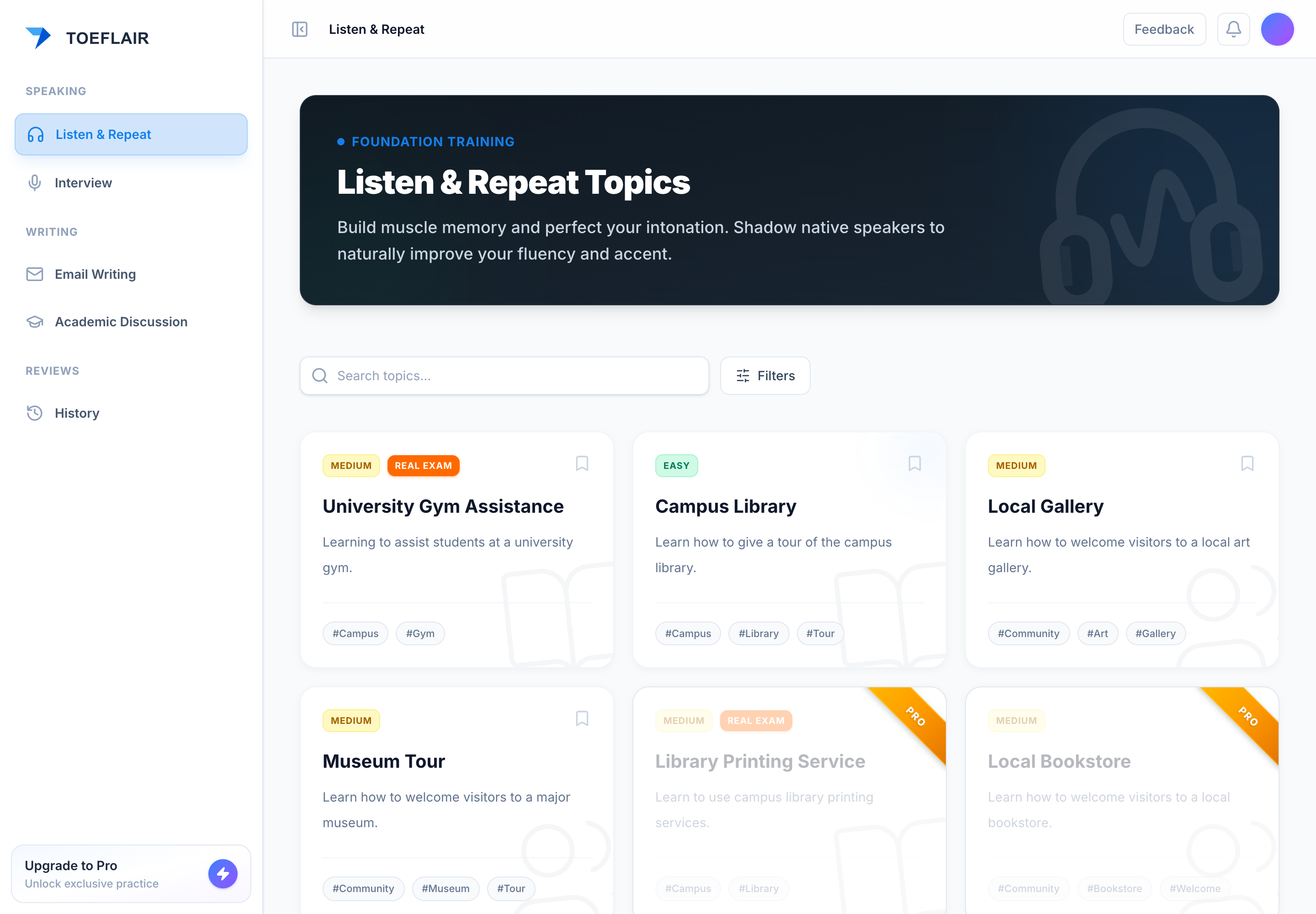
Pick one that matches a scene you find hard. We’ll use University Gym Assistance for the rest of this walkthrough.
You get exactly one listen
The one rule that makes this task hard: the audio plays a single time. There’s no transcript and no replay. You listen, hold the sentence in working memory, and repeat it as accurately as you can. The sentences get longer as you go, so the last two push past what you can parrot and force you to actually understand before you reproduce.
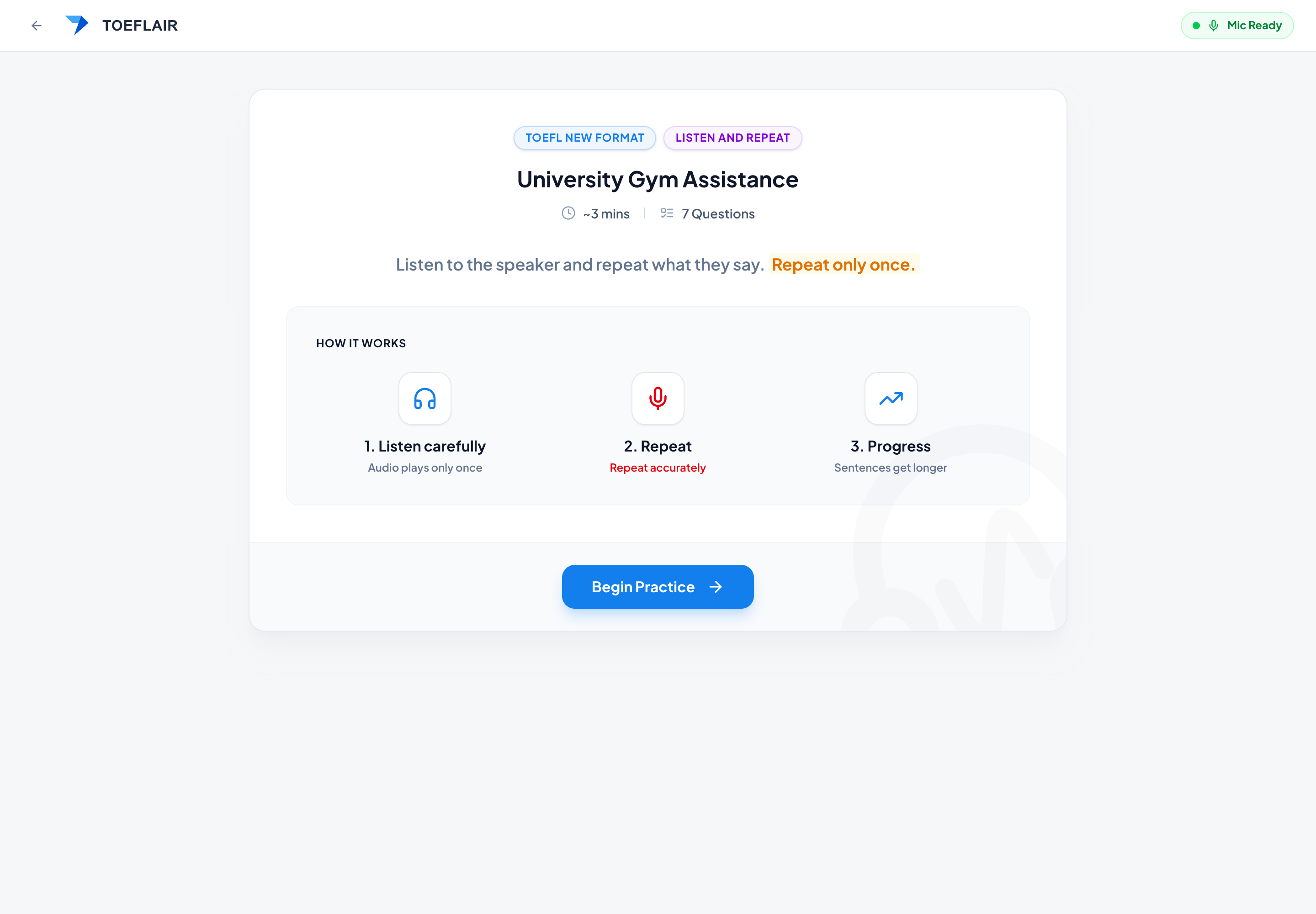
Hit Begin Practice, record all 7, and the report builds itself.
See which sentences dragged
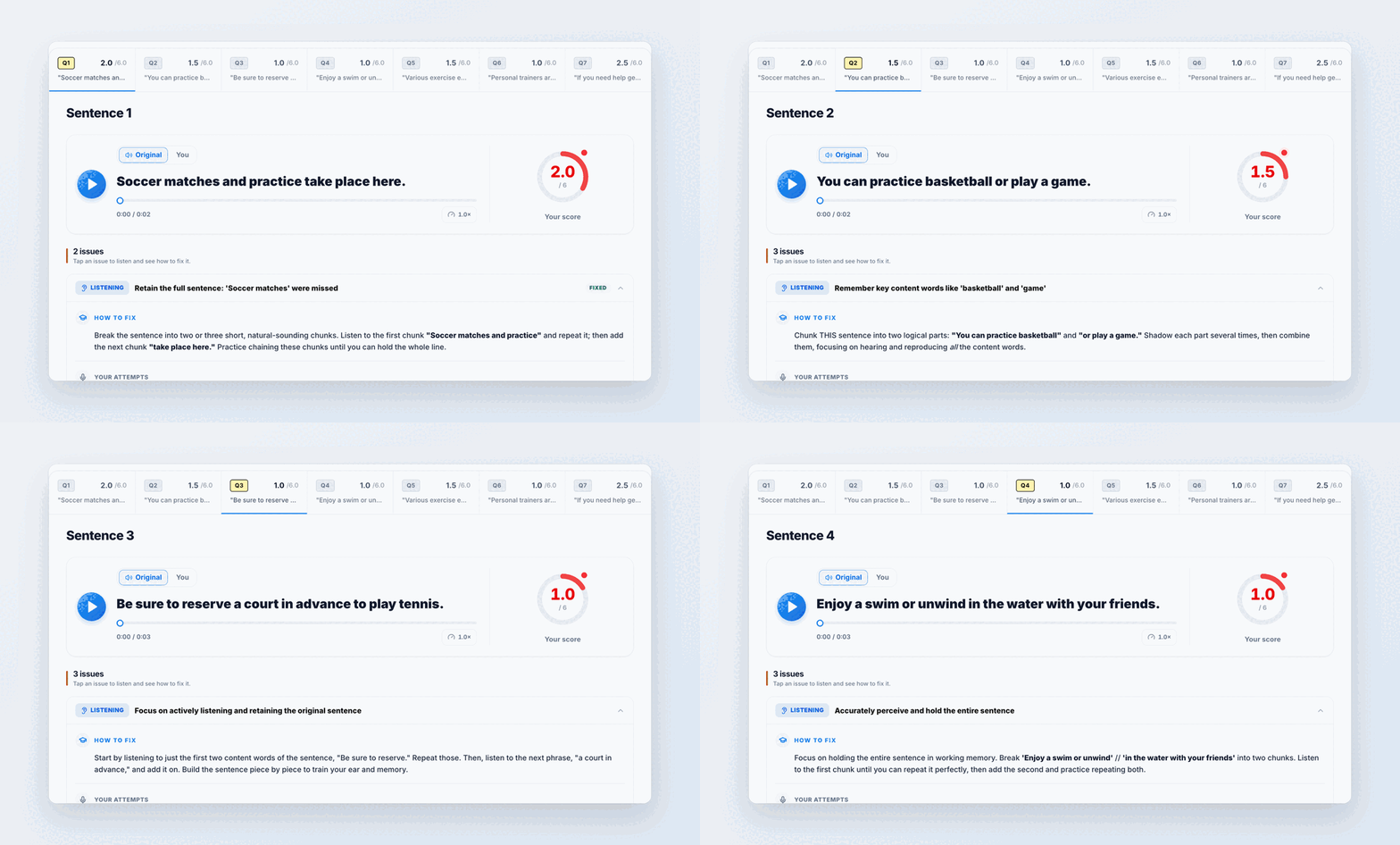
The report opens with all 7 sentences as tabs, each with its own band. This is the first thing to read: not the overall number, but which sentences dragged. In this session the scores sit between 1.0 and 2.5. The pattern already tells a story: the longer sentences (Q3, Q4, Q6) fell hardest, which points at retention rather than pronunciation. Open the lowest one first.
Clicking any tab opens that sentence’s own breakdown, so you can move through the set one problem at a time:
Read the cause, not the number
This is the heart of 2.0. Open a sentence and every mistake shows up as its own issue. Tap any one to see its cause and how to fix it.
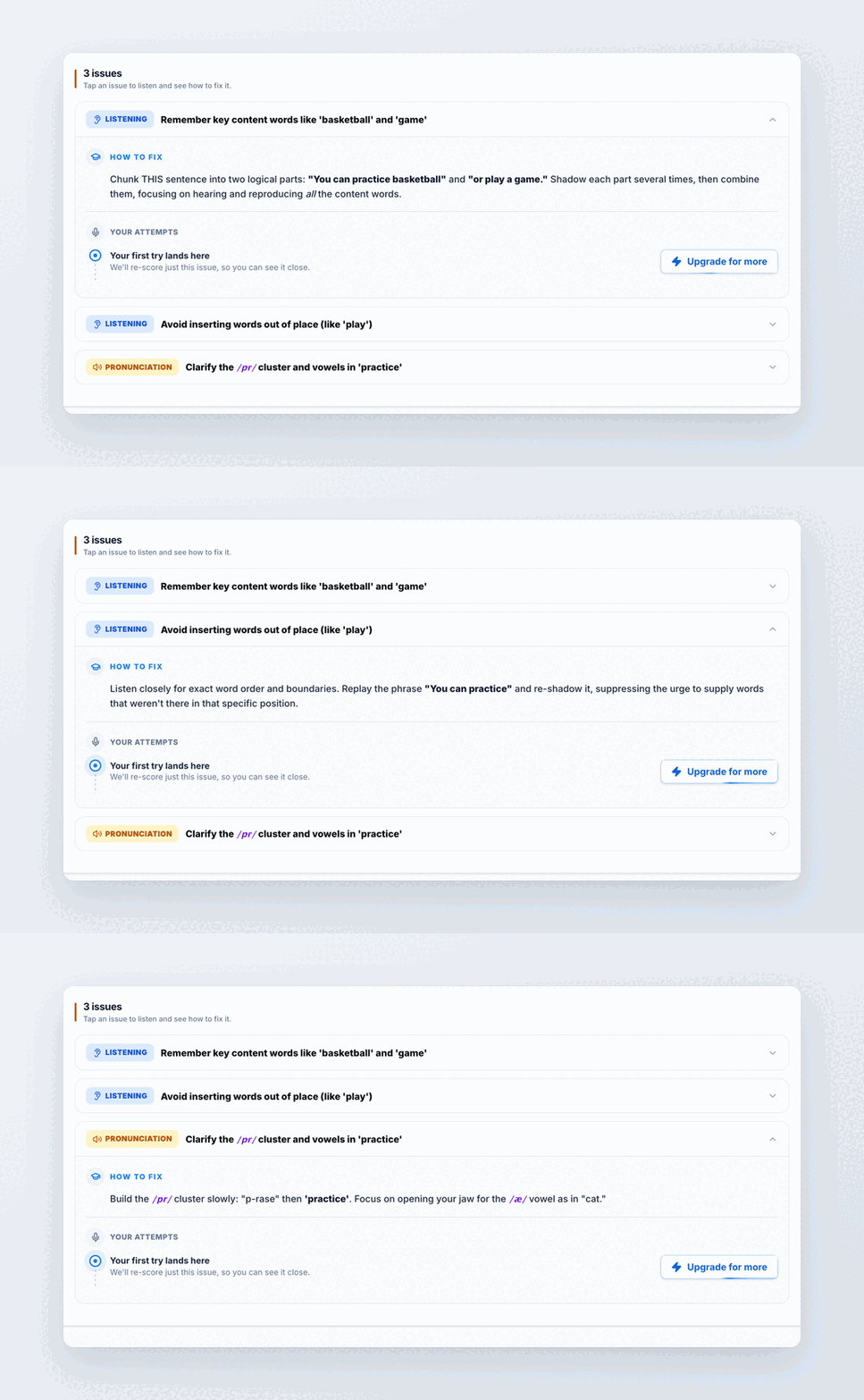
Read the badge before the number. Each issue is one of three causes:
- Listening (blue) — you never caught the sound. A missed content word, a dropped tail on a long sentence, an inserted word that wasn’t there. This is your ear and working memory, not your mouth.
- Pronunciation (amber) — you caught it but your mouth mis-formed it. A
/l/–/r/swap, a devoiced/z/, a vowel cut short. - Expression (violet) — the words are right but the delivery is flat or broken: a monotone line, an unnatural pause.
Each issue also comes with a HOW TO FIX note written for that specific mistake — here, chunking “You can practice basketball” + “or play a game” and shadowing each half before joining them.
Hear the gap for yourself
Inside the sentence, the player has an Original / You toggle. Play the model, then play your own recording right after it. Hearing them back to back is how a /r/ that “sounded fine” in your head suddenly stands out.
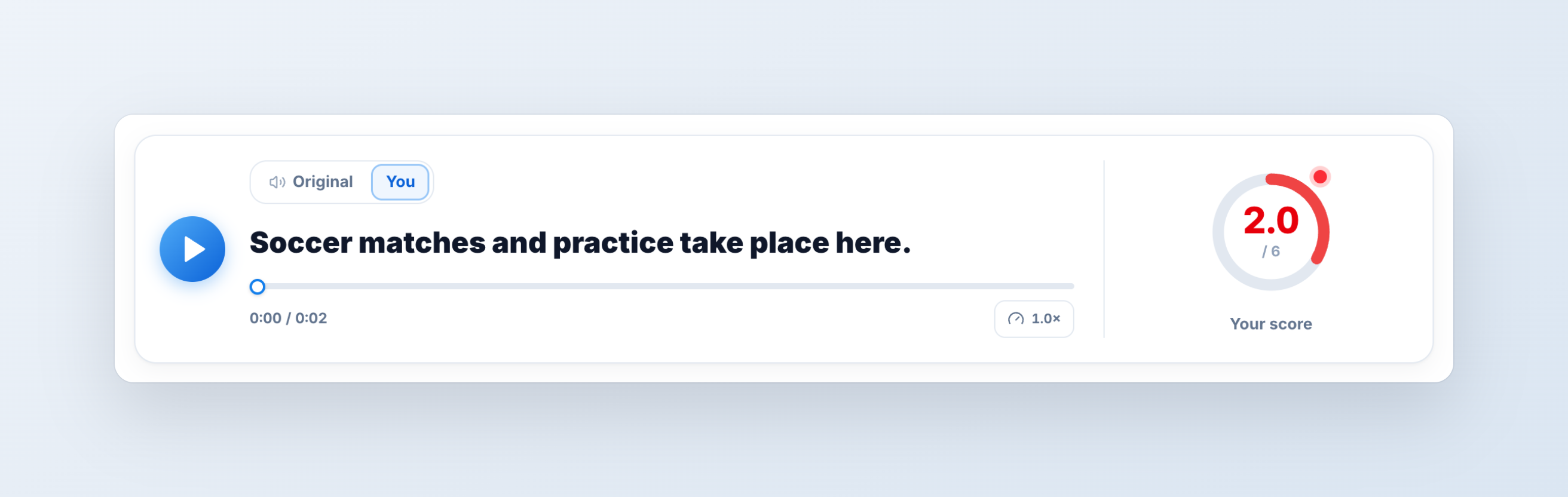
The point isn’t to listen once and move on. It’s to A/B the exact word the issue flagged until you can hear the gap yourself.
Fix it in place, until STILL reads FIXED
This is the loop the whole report is built around. Under an issue, Repractice reopens just that one sentence. You record a new attempt, and it’s re-scored against that specific issue — not the whole set. The attempt shows up as a new row with its own score and a status badge.
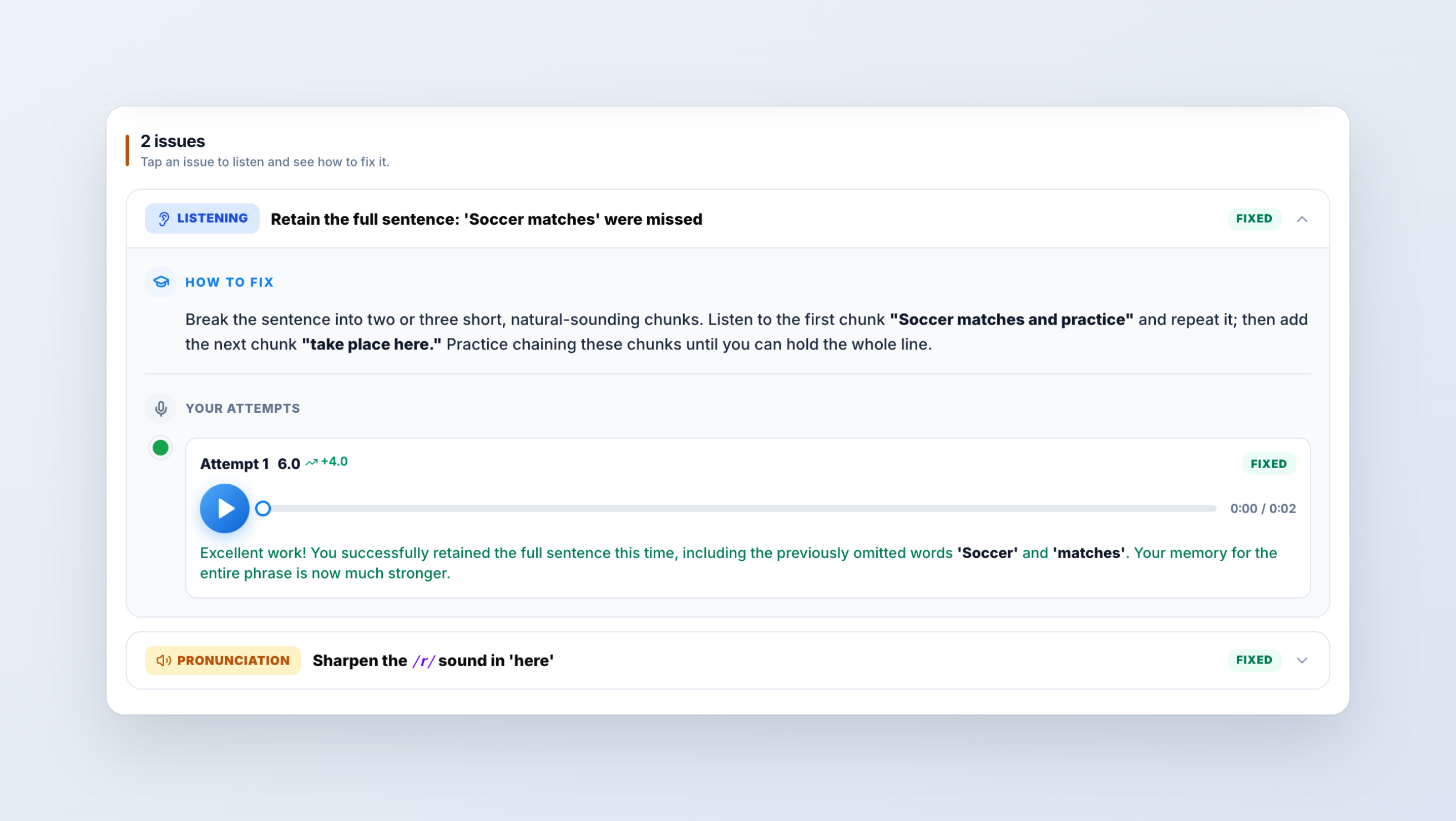
Status moves in one direction only: STILL → IMPROVED → FIXED. When the row reads FIXED with a green check, that specific problem is closed. You’ve turned “I scored low” into “I fixed the missed words on sentence 1” — a concrete, checkable win instead of a vague re-do.
Work down the sentence tabs, fixing the lowest first, and the score takes care of itself.
Don’t drill the wrong thing
One habit is worth building from day one: trust the cause, not your instinct. Most students assume a low Listen & Repeat score is a pronunciation problem and start drilling sounds. In our data, roughly two-thirds of the lost points are actually Listening — you didn’t catch the word, so of course you couldn’t repeat it. The cause badge exists to stop you from drilling the wrong thing. If the badge says Listening, more sound practice won’t move it; shadowing and chunking will.
The score was never the point. The fix list is.