

Magoosh will tell you which words you got wrong. TOEFLAIR will tell you why you got them wrong: whether you never heard the word, could not hold it, or could not say it.
Both tools score your speaking and writing automatically now, and both name specific words. So the old dividing line is gone, and the one that replaced it sits a layer further down. We worked through all four 2026 task types on Magoosh in a free trial and read what its reports return, then put that next to what ours return.
How We Checked This
Everything below about what Magoosh’s reports return comes from a free trial we used on August 4, 2026. In one session we answered Listen and Repeat, Interview, Write an Email, and Academic Discussion questions and read each report that came back.
On October 23, 2026 we re-read Magoosh’s public TOEFL pages. We read its home page and plans page, its score guarantee page and its 2026 changes page. We did not run the product again, so nothing about its reports has been re-tested since August 4. The prices, the no-renewal policy and the 7-day trial offer on those pages match what this post listed in August.
What Magoosh’s Report Returns
In the August 4 trial, Magoosh graded our spoken and written output automatically, question by question. Each response gets a score out of 5, with half points, and the session gets an overall score built from them.
For Speaking it returns four numeric facets per response, on a 0–100 scale. On Listen and Repeat those were Similarity, Pronunciation, Pauses, and Speed. On Interview they were Relevance, Pronunciation, Grammar, and Speed. Underneath sits a transcript of what you actually said, placed next to the prompt, and a paragraph of written advice.
That advice is specific. It names words:
You captured the idea of improving the signal, but several key words were changed, making the sentence inaccurate. Focus on clearly repeating “antenna,” “on the device,” and “for a stronger signal” — for example: “Adjust the antenna on the device for a stronger signal.” Practice the sounds in “antenna” (an-TEN-uh) and “device” (di-VICE).
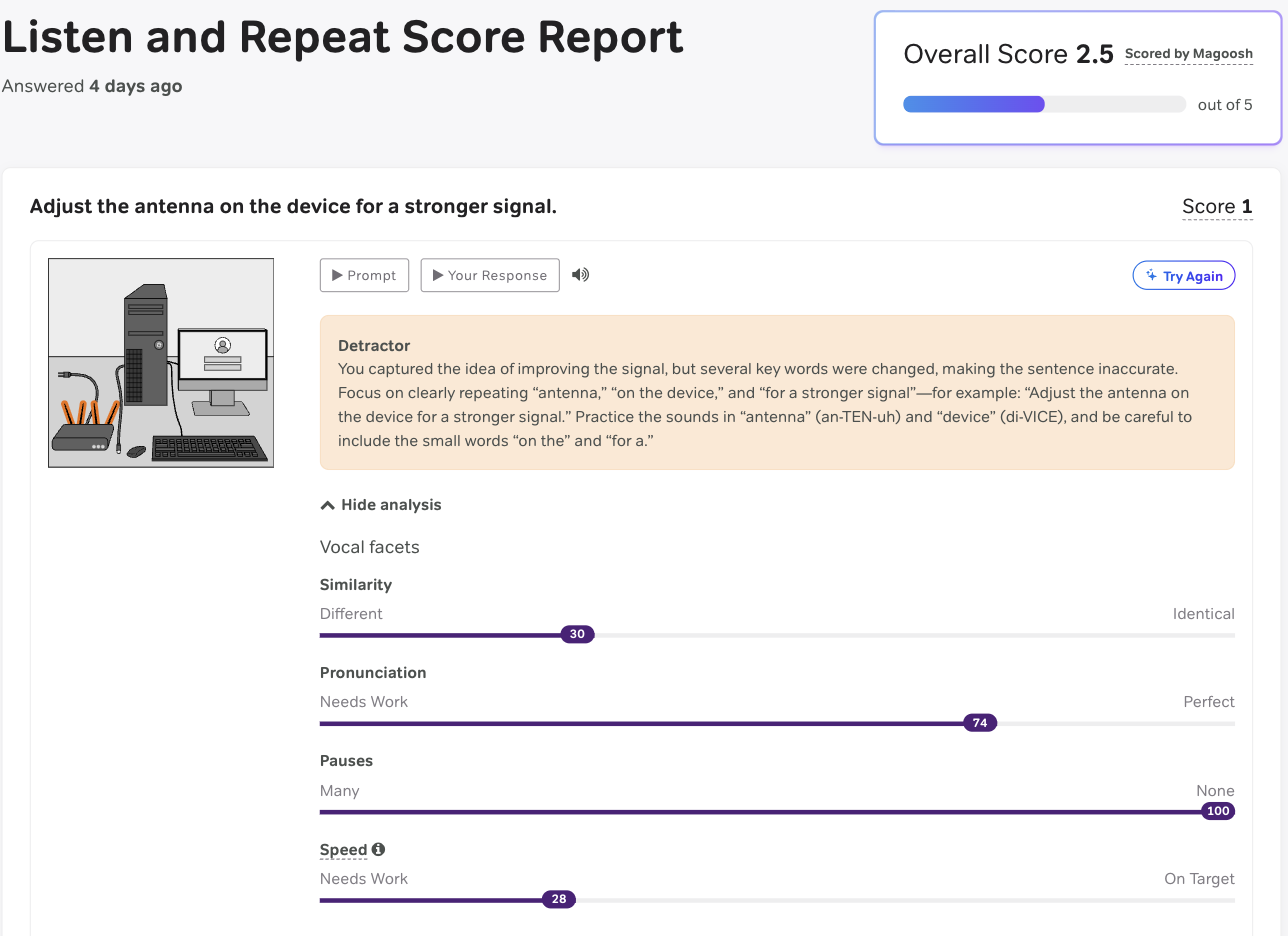
Its own sliders sit against its advice. Pronunciation came back 74 and Similarity came back 30, so the facet it told us to drill is the healthy one.
Phoneme-level coaching, from a machine, in seconds. Its scoring links out to ETS’s own rubric, and every claim above comes from the reports we read in the August 4 trial. If you want their own account of the feature set, Magoosh’s plan page is the source.
What TOEFLAIR’s Report Returns
TOEFLAIR covers Speaking and Writing only, across the same four task types, and scores each one on the official 1–6 band scale in 0.5-point steps rather than out of 5.
Every issue it finds gets sorted into one of three cause layers before anything else happens:
| Layer | The question it answers | How it reads on your report |
|---|---|---|
| Listening | Did you take it in and hold it? | ”You omitted the word your, which often reduces to a weak form /jər/ in natural speech, especially when linked quickly to the preceding word.” |
| Pronunciation | Could you articulate it? | ”The word for was mispronounced, particularly the reduced vowel sound and the subsequent /r/.” |
| Delivery | Did it come out naturally? | ”You introduced an unexpected break between the words paper and tray, which made the phrase slightly choppy.” |
The classes are a closed set, and listening classes are assigned in code from the timing and omission signal rather than by a language model, so the label is reproducible rather than a guess. Two of the things they measure have no counterpart in the Magoosh reports we ran: linking, and intonation.
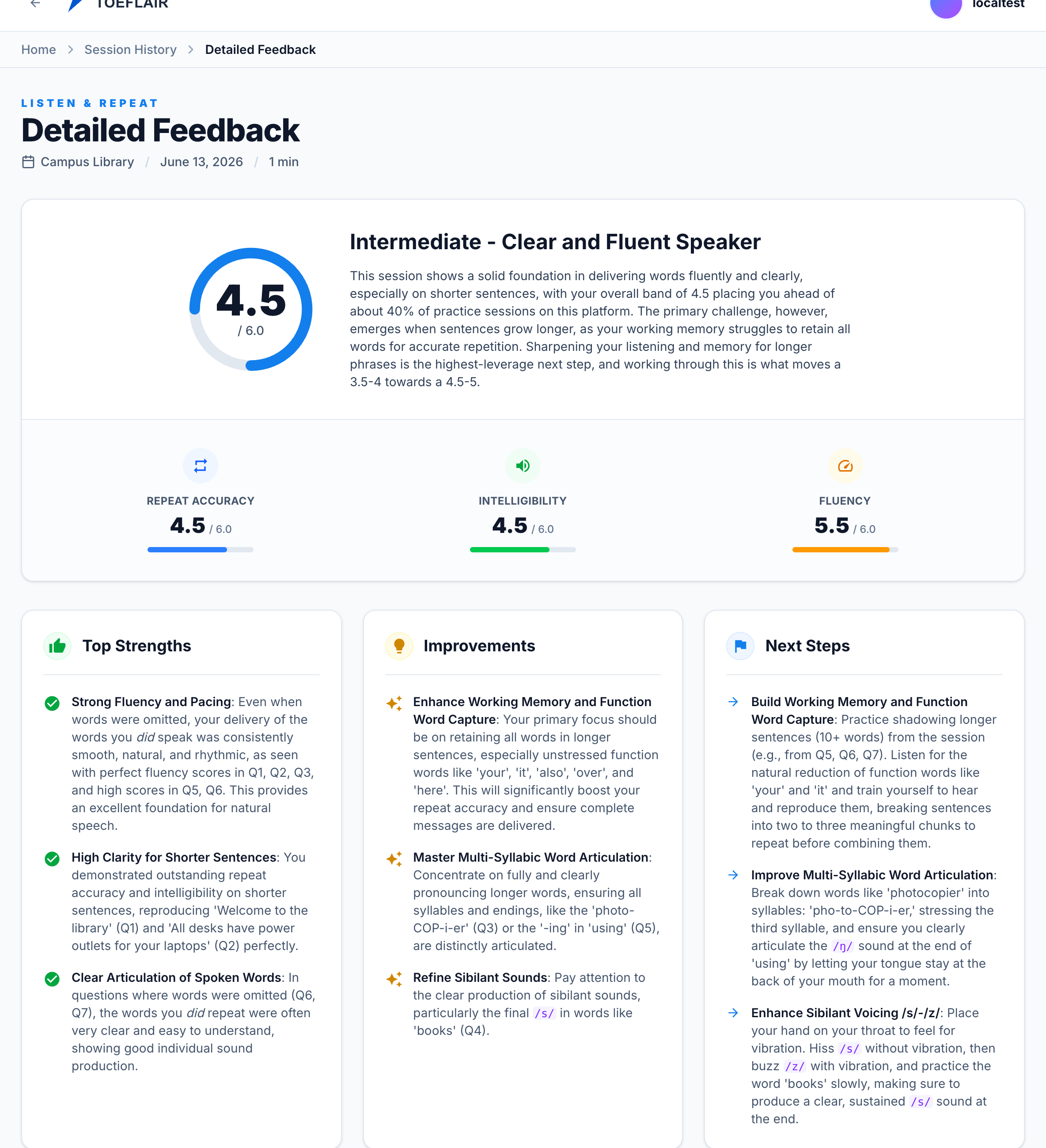
One report, two layers, two unrelated drills: chunk the sentence for the memory failure, break the syllables for the articulation one.
On Interview, the report splits your answer into its actual moves: opening, support, and closing. Each move carries a time budget, and the report names which one was weak. That is different from being told what a good structure looks like, and it is the part that transfers between prompts.
One Sentence, Two Readings
One sentence shows where the two reports diverge. The prompt was “Adjust the antenna on the device for a stronger signal.” What came back was “Adjust the internal by internet signal.”
Magoosh scored it 1 out of 5 and returned Similarity 30, Pronunciation 74, Pauses 100, Speed 28. It advised practising the sounds in “antenna” and “device.”
Pronunciation is the higher of those two facets. Similarity is the low one, and the response stops after its third word: the entire tail is missing. Those numbers describe a sentence that was never fully held, not one that was mispronounced.
TOEFLAIR classifies that pattern, clustered omissions in the tail of a sentence longer than seven words, as a memory tail-dropout. The prescribed drill is not phonetic. It is to chunk the sentence into two or three sense groups and rehearse the chunks, then ladder the length back up. Practising “an-TEN-uh” for a week would not move it.
That is the case for naming the cause before prescribing the drill. Across roughly 100 targeted retries we sampled, the mean band on the retried sentence was 5.0 against 3.5 on the first attempt: same sentence, same student, with the flagged issue named in between. Read it as how much a sentence recovers once you know what broke, not as a score gain on the test. Here’s what that loop looks like end to end.
Writing: Editing Your Draft, or Unpacking the Task
Both tools go well past a single number on the Email task, in different directions.
Magoosh ties your score to the rubric criterion by criterion. Ours came back with four lines explaining the band we got, including “Adequate elaboration to support the communicative purpose,” and two explaining the band we did not, including “More than near-zero grammatical errors prevent the top band.”
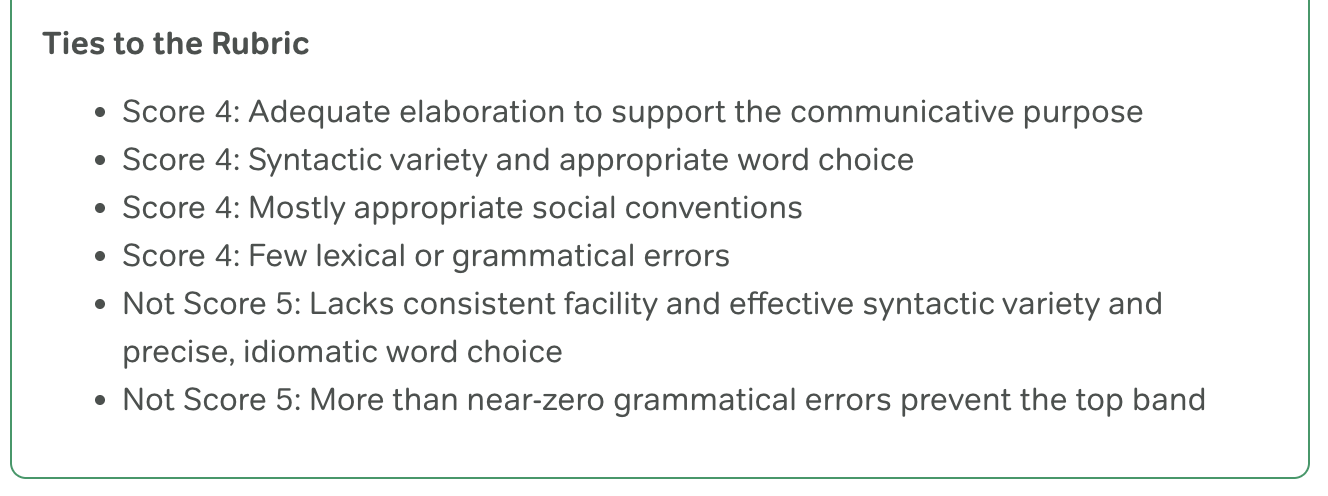
Four lines for the band it awarded, two for the band it withheld, each one tied to a named rubric criterion rather than to a number.
It then offers Suggested Edits: a full rewrite of your own email, with every change filed under a theme such as Grammar and Spelling or Adherence to Task. Magoosh labels the feature experimental and frames it as worth about one score point.
TOEFLAIR starts one step earlier, at the prompt. Every Email task carries a numbered list of requirements, and the report audits them one at a time, separating a requirement you missed from one you covered too thinly. Both cost you points, for different reasons.
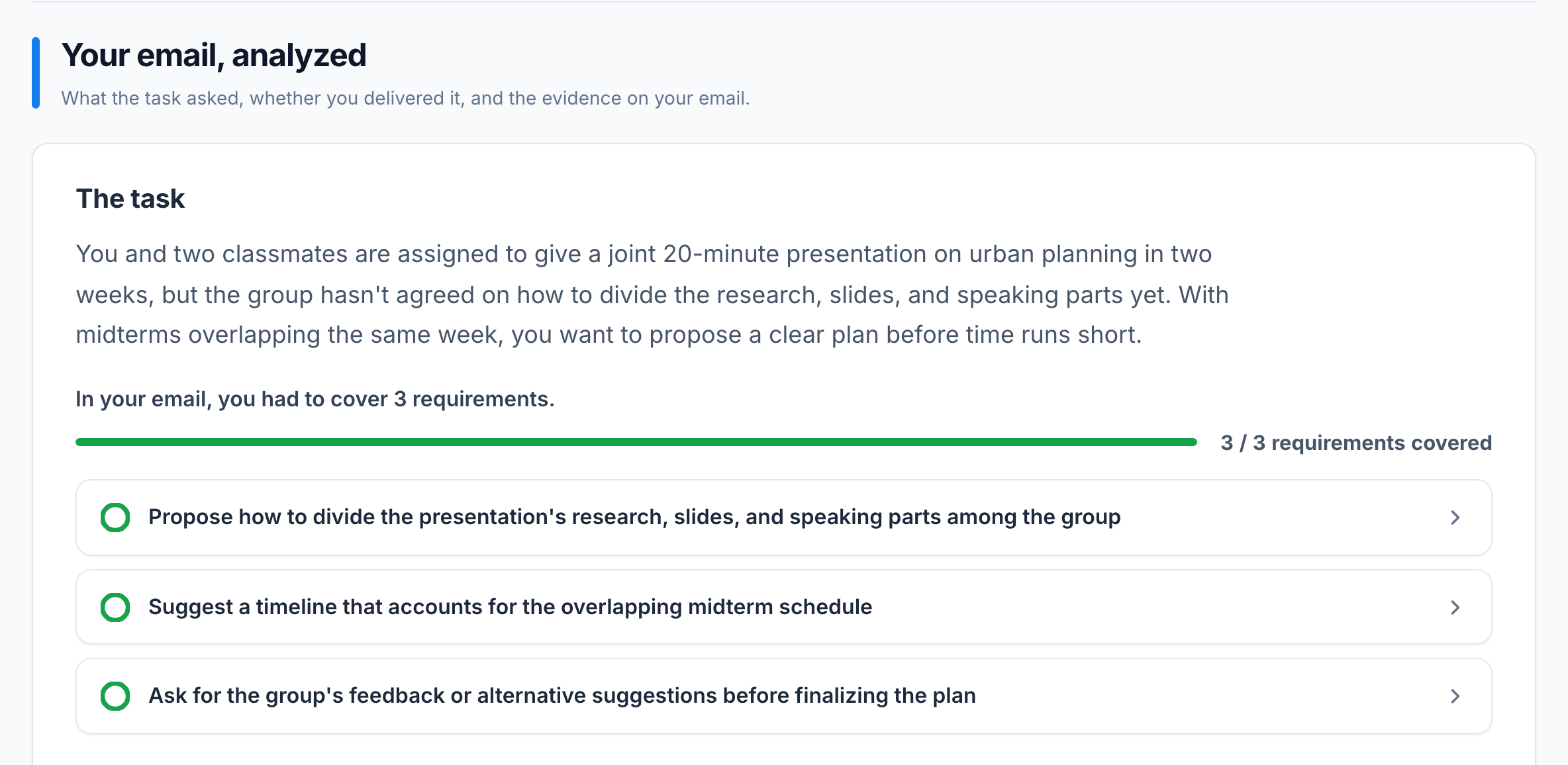
The prompt is broken into numbered requirements and each is checked off on its own, before any of the writing itself is graded.
Its model answer is built the same way. The body is split into four to six beats, each anchored to one real paragraph, each named for what that paragraph is doing in this specific answer rather than a template label. Each beat states its job at planning level and which numbered requirement it serves. Grammar usually isn’t the dimension doing the damage.
So one tool improves the draft you wrote, and the other shows the plan you could have written from.
When Magoosh Makes More Sense
Magoosh is the better fit if:
- You are new to the TOEFL and need to understand all four sections
- Reading and Listening are where you are losing points
- You want a guided study schedule with structured video lessons
- You prefer watching an explanation before attempting practice questions
- You are several months out and want comprehensive coverage
Its Speaking and Writing feedback is no longer the thin part of the product. What it gives you is a graded diagnosis of the response you just produced, across all four sections of the exam, inside a course that also teaches you the format.
When TOEFLAIR Makes More Sense
TOEFLAIR is the better fit if:
- Speaking and Writing are where you are losing points
- You already know the format and want targeted drilling
- You keep getting told what went wrong without learning why it went wrong
- Your repeats fall apart at the end of long sentences, or your delivery sounds flat
- You know what you want to say, and organising it is the hard part
It does not teach you the exam. It assumes you know it, puts you under exam conditions, and spends its whole report on separating causes that a single score blends together. Two of the four task types are writing tasks, where that question takes a different form: which requirement did you miss, and which did you cover too thinly?
Using Both Together
These are not mutually exclusive, and the split falls out of what each one returns. Magoosh early, while you still need the format explained and all four sections covered. TOEFLAIR in the weeks before the test, when the question stops being what the task is and becomes why your answer keeps losing the same half band.
Pricing at a Glance
| Magoosh TOEFL | TOEFLAIR | |
|---|---|---|
| Free tier | One-time 7-day trial | 5–6 free practice sets per task type, unlimited attempts, no card |
| Paid plan | $109 / 1 month $129 / 6 months | $20 / 1 month $51 / 3 months $90 / 6 months |
| Auto-renewal | No | No |
| Coverage | All four sections | Speaking and Writing only |
| Output feedback | Score out of 5, numeric facets, written diagnosis, rubric ties, essay rewrite | 1–6 band, cause-layer classification, requirement audit, annotated model answer |
| Retry a response | Premium only | Free plan includes 2 per Listen & Repeat session |
Magoosh’s prices are the regular prices on its plans page as we read it on October 23, 2026. A 30% promotion code was running that day and was due to expire on October 26, and promotions change, so check the page before you buy. The last two rows of the table describe the reports we saw in the August 4 trial; Magoosh’s public pages do not list them.
Magoosh’s 6-month plan works out to about $21.50 a month for four sections; TOEFLAIR’s 3-month plan is $17 a month for two. If you need Reading and Listening, Magoosh is the better value. If you do not, you are paying for a curriculum you will use half of.
Neither plan renews on its own, so neither quietly bills you again. Magoosh also lets you split the 6-month plan into four payments of $32.25, which is a payment schedule for that one purchase, not a subscription.
The Short Version
Both tools now score your output and both tell you what went wrong in it. That used to be the whole comparison, and it no longer is.
What separates them is one layer further down. Magoosh tells you which words you got wrong and how to say them. TOEFLAIR asks which ability failed first: hearing it, holding it, or saying it.
It answers that before prescribing anything, because a memory failure and a pronunciation failure produce the same wrong sentence and respond to opposite drills.
If Reading and Listening are still shaky, start with Magoosh. If they are handled and Speaking or Writing is what is left, the narrow thing we built for is telling those failures apart.
Further reading
- Magoosh TOEFL pricing and plan details — the source for the Magoosh pricing above, read on October 23, 2026
- Magoosh’s TOEFL 2026 changes page — read on October 23, 2026
- How accurate is an AI TOEFL Speaking grader? 674 attempts
- Why memorizing fails the TOEFL Interview
- The best TOEFL AI feedback tools, ranked by depth
- What changed on the TOEFL in 2026