


In short: Every Email Writing lists exactly three points your reply must cover. Our Toeflair team reads every point in our bank and classifies them into four categories — one of which splits three ways, depending on what you’re asking for. Two pairs of those look alike and test different things. Restating a fact isn’t explaining its impact, and asking for an action isn’t the same as asking for information.
The Email Writing task gives you a situation and a list. Most advice treats that list as a checklist: hit all three, don’t miss one, you’re fine. That’s true but not the whole picture, because it treats the list as everything Email Writing is.
In fact, Email Writing isn’t that simple. We measured every active question in our own Email Writing bank on 2026-09-18, and the three bullets turn out to have different jobs. For the format facts — how many minutes, how many words, how it’s scored — we keep those in our guide to TOEFL email writing.
Every question gives you the same four parts
Before the measurements, the shape. There are 4 aspects sitting in every question:
- a scenario telling your identity and what has happened
- a named recipient with a job title
- the instruction to write to that person
- the required points your reply has to cover
Every question in our bank carries all four elements.

And the required points are always three. Not usually three. In every active question in our bank the list runs to exactly three, with none carrying two and none carrying four.
Here is one in full:
You are an international student living in the on-campus dormitory at Westlake University. For the past three weeks, construction work on the building next door has been causing loud noise every morning starting at 7 a.m., making it very difficult for you to sleep and study. You would like to move to a quieter room in a different building for the remainder of the semester. Write an email to the Housing Office coordinator. In your email, do the following:
- Describe the noise problem you have been experiencing and how long it has been going on
- Explain how the noise is affecting your sleep schedule and your ability to prepare for your midterm exams
- Request a room transfer to a different dormitory building and ask what steps you need to take to begin the process
Read those three bullets again as three separate instructions rather than one checklist.
“Describe” comes first — put the noise problem and its three-week timeline on the record. That looks like the easy one, but a response that only says “there has been a lot of noise” is still vague. The three-week timeline and the daily 7 a.m. detail are what make it a specific, checkable fact rather than a complaint.
The second bullet asks for more than a repeat of the first. “Explain” means connecting that fact to a cost. Saying “it’s been difficult” repeats the first point in different words rather than answering the second one. Naming the two concrete costs — a disrupted sleep schedule and less time to prepare for midterms — is what actually explains the impact.
The third bullet needs two different things — “request” an action, then “ask” for missing information. A response that only says “I would like to switch rooms” names the action but stops there. It never asks what the recipient still needs to know, and the bullet has two halves that both need an answer.
Four things a required point can ask you to do
Read every required point in the bank and they sort into four categories. Not four topics — four things the point asks you to do, and one of them takes three shapes.
| The job | What the point wants from you |
|---|---|
| State a fact | Put something on the record: what happened, what you have, who you are |
| Explain the impact | Say why it matters — what it cost you, or the reasoning behind your position |
| Action request | Request an action: ask the recipient to do something, like process a refund Request information: ask the recipient to tell you something, like what steps come next Propose a fix: hand the recipient a solution instead of waiting for one, like suggesting a payment plan |
| Relationship move | Thank, apologize, acknowledge, or commit to something |
Three of the four categories are already on this page. The dorm-room question above runs, in order:
- State a fact — the noise problem, and how long it has been going on
- Explain the impact — your sleep, and your ability to prepare for midterms
- Action request — a room transfer, plus the steps to start one (the request an action shape)
Request information is the other shape of action request. Instead of asking the recipient to do something, it asks them to tell you something they know and you don’t. A response that only asks “please let me know” doesn’t say what there is to know. Naming the exact gap — which steps, by when, from whom — is what turns a vague ask into an answerable one.
Propose a fix flips who does the offering. Instead of asking the recipient what should happen, the writer states what should happen. A response that only says “I hope we can find a solution” hands nothing back — they still have to invent the fix. Naming an actual arrangement, down to a date or an amount, is what makes it a proposal rather than a wish.
Relationship move is the one category that isn’t a request at all. Thanking, apologizing, acknowledging a mistake, or committing to something asks nothing of the recipient — it settles something between the two of them instead. Skipping it doesn’t feel like answering a question wrong. It reads as leaving a social debt unpaid.
The first mix-up shares a surface move. State a fact and explain the impact are both declarative sentences about the situation, which is why restating one can pass for answering the other.
State a fact is “construction started three weeks ago”. Explain the impact is “so I cannot prepare for midterms”. Answering the second by repeating the first covers the point on paper without actually answering it.
The second mix-up shares a different surface move. Request an action and request information are both the writer asking for something, so they read alike on the page. What separates them is what the recipient has to produce next — a result, like a waived fee, or an answer, like the steps to get one waived.
You are almost never writing to a peer
Which raises the second thing the question answers before you write a word: who is reading this?
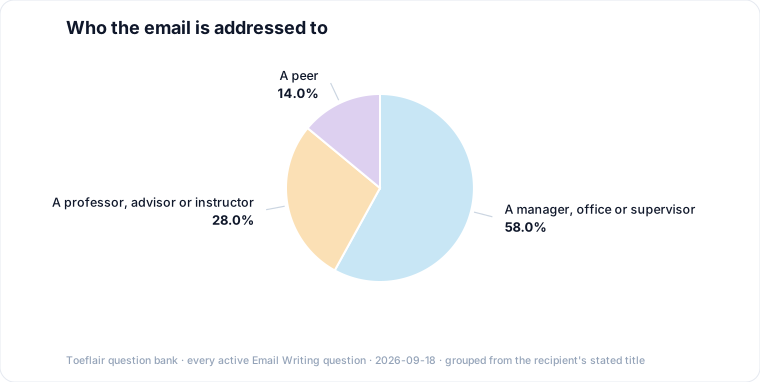
Grouped by the recipient’s stated job title, barely one in seven address a peer — a friend, a classmate, a neighbor or a group member. Everyone else is a manager, an office, a professor, an advisor or an instructor: people you don’t share a social relationship with. So for the vast majority of questions, you are writing to someone you don’t know socially. That person holds the outcome you want, and you are about to ask them for something.
Writing to a stranger changes what the email has to carry. A friend or a classmate already shares some of your context — they might already know about the noise, the schedule, the delay. A manager, an office, or an instructor almost never does, and that’s who most questions address. Because the recipient starts with no shared background, the three required points can’t lean on anything left unsaid — every fact, cost, and request has to stand on its own.
The scenario you read before writing is not something the recipient ever sees. Whatever in it matters to your case — what happened, how long, what you’ve already tried — only reaches them if you put it in the email yourself. That’s what the state a fact category is actually doing: carrying the relevant parts of the scenario across that gap.
Who the recipient is does not change which of the four categories the three points fall into. The same four show up whether they’re a professor or a friend. What it changes is what your wording has to carry. In most questions the closing point asks something of a person who outranks you in that situation.
That is why register is scored rather than admired. ETS’s published Write an Email scoring guide reserves its top level for responses showing:
Consistent use of appropriate social conventions (e.g., politeness, register, organization of information and formulation of actions such as requests, refusals, criticisms, etc.)
Note what sits inside that sentence: “formulation of actions such as requests”. How you ask is not a finishing touch applied to finished content. It is the content of the closing point.
The scenarios stay deliberately ordinary
Range matters for a practical reason. An unfamiliar setting costs you vocabulary you would otherwise have free.
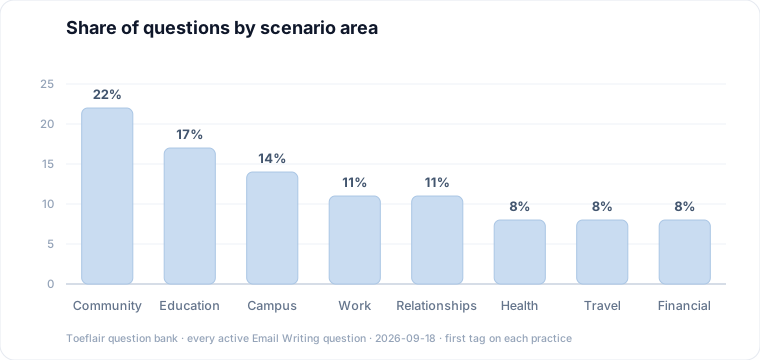
Eight areas, and no single one takes more than a quarter. Community leads at a little over a fifth, followed by Education and Campus, with Health, Travel and Financial tied at the bottom.
The situations themselves are as plain as that spread suggests: a defective order, a billing dispute, a schedule conflict, a missed appointment.
Compare that to Listen & Repeat, where Campus alone accounts for more than a third of the sets. The email bank is flatter on purpose, because the task needs situations in which writing to a stranger is the natural next move, and campus life supplies only some of those. In practice, studying campus vocabulary covers about one question in seven.
What to actually do with this
Three things follow from the numbers above.
- Name each point’s job before you write a word. Explaining the impact is not answered by describing the situation again, and asking the recipient to act is not answered by asking them a question.
- Find the recipient’s job title before you choose a greeting. Most questions address someone senior to you in that situation. Formal is the safe default. Informal is the exception, and the question names which one you’re in.
- Write the request as a specific action, not a general wish. “Could you let me know what steps I need to take?” answers the third bullet. “I hope this can be resolved” doesn’t.
None of this depends on having seen the question before, which is the point. The shape transfers and the scenarios don’t.
If you’d rather feel the shape than read about it, our Email Writing practice scores a real question across all four writing dimensions and shows which required points you actually covered. The companion piece on the speaking side, what TOEFL speaking questions actually look like, runs the same measurement on Listen & Repeat and Take an Interview. And if you want the how-to rather than the what, how to practice TOEFL writing covers the drills.
Further reading
- ETS, TOEFL iBT Writing Scoring Guides — the official Write an Email scoring guide, including the social-conventions descriptor quoted above.
- TOEFL email writing: grammar isn’t what raises your band — the format facts and how to answer a question once you’ve read it.
Figures in this post come from every active Email Writing question in the Toeflair question bank, measured 2026-09-18. The four categories are a hand classification of every required point in the bank, recorded point by point so it can be audited. Classifying this by hand a second time would move a handful of borderline points between request and propose. Recipient groupings are taken from each question’s stated recipient title. ETS’s 0–5 task scoring guide and the 1–6 scores our reports show are separate scales. No conversion between them is published, and none is implied here.