


In short: A Listen & Repeat set climbs a predictable ladder — every sentence is longer than the one before it, 6.6 words up to 12.8. But length is not what makes the last one hard. Grammatical complexity stays nearly flat for four sentences and then goes vertical: at sentence 1, none of our sets use a subordinate clause; at sentence 7, four in five do. Length and complexity are two separate knobs, and only one of them turns at the end.
Search for TOEFL speaking questions and you’ll still land on a PDF of 180 of them. It was a good resource. It is now a museum piece: the 2026 redesign replaced the old Speaking section outright, and not one of those 180 prompts appears on the test anymore.
The useful question isn’t which questions you’ll get — you won’t get any specific one, and nobody can hand you the list. It’s what the questions are shaped like. That’s knowable, it’s stable, and it’s what you can actually prepare against.
So we measured ours. Everything below comes from every Listen & Repeat sentence and every Interview question in our own bank, as of 2026-09-17. Counts and definitions are stated as we go, so you can check the reasoning rather than take our word for it. If you need the format facts first — how many tasks, how long, how much prep time — we keep those in what changed in the 2026 TOEFL.
The seven sentences climb a ladder
A Listen & Repeat set is seven sentences, and they are not seven samples of the same thing. They fall into three length tiers: two short, then three medium, then two long.
That shape isn’t our invention, and it isn’t a secret. TOEFL Resources, whose public Listen & Repeat guide is among the most widely cited, describes the same structure in their own words:
The sentences gradually get longer. There are two “short” sentences, three “medium” sentences and two “long” sentences.
Our sets are built to that same documented structure. Here is what it weighs, averaged across every sentence in our Listen & Repeat bank:
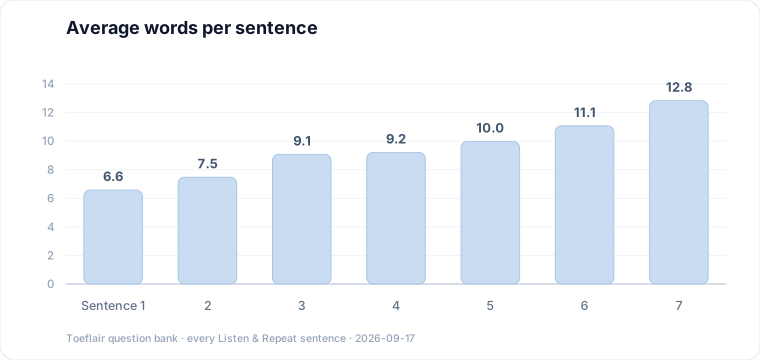
Seven bars, seven steps up. Every sentence is longer than the one before it — 6.6 words at the start, 12.8 by the end, with no step backwards anywhere in the run. This is a rule rather than a tendency: in all but two of our sets the three tier averages climb strictly, and in every single one the long sentences outweigh the short ones.
Here is one whole set, end to end:
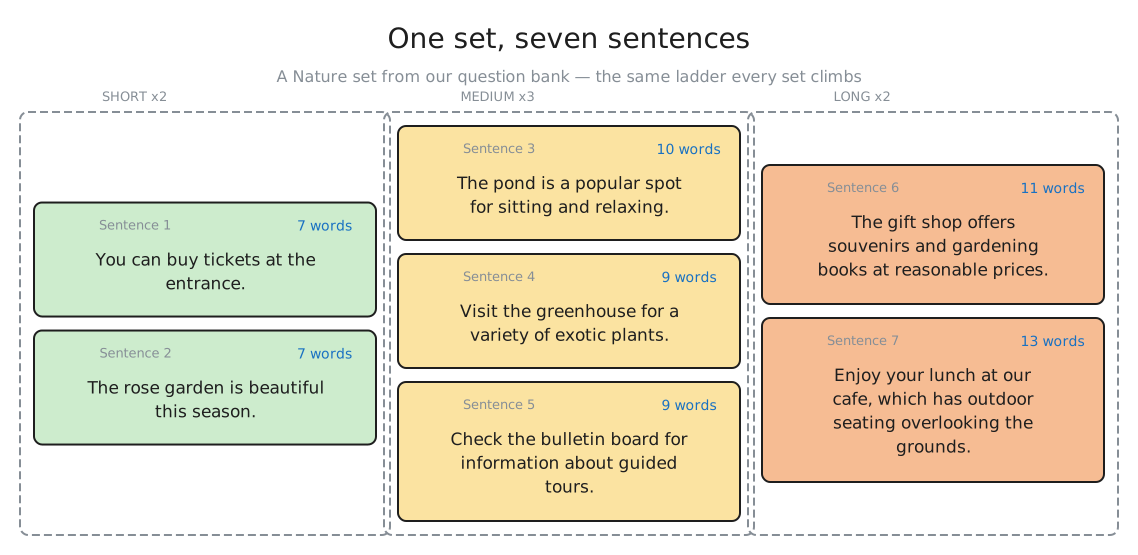
Note the wobble: sentence 4 is shorter than sentence 3. That is what every set looks like up close — the tier-to-tier trend is reliable, the step-by-step is not. And notice where the last sentence spends its extra words: not on more things to remember, but on a clause hung off the end of the main one.
The memory load grows, you know roughly when, and you can pace yourself. That’s the part everyone already tells you.
Length is not what makes the last two hard
Here’s the part nobody tells you, and it’s the more useful half.
If length were the whole story, sentence 7 would just be sentence 1 with more words bolted on — harder to hold, but no harder to parse. That’s not what’s in the bank.
Now measure a different thing on exactly the same sentences. Not how many words, but whether the sentence is complex — whether it hangs a subordinate clause off the main one instead of just stating a fact.
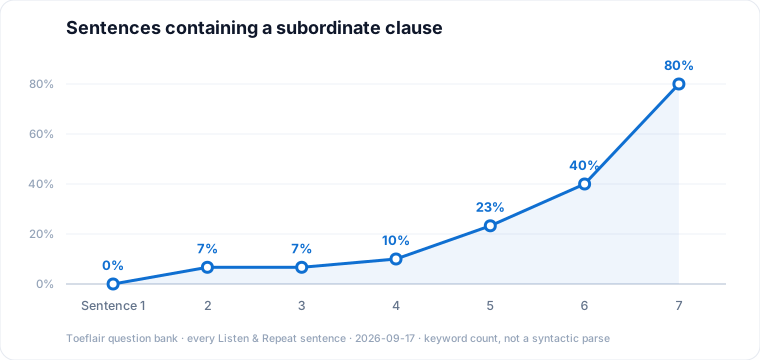
Put this line next to the bars above. Same seven sentences, completely different shape. The bars climb one even step at a time. This line lies almost flat for four sentences — and then, at the last one, it goes nearly vertical.
The endpoints say it fastest. At sentence 1, not one of our sets uses a subordinate clause. At sentence 7, four in five do.
A sentence counts as complex here when it contains one of fourteen subordinating words — that, which, who, because, although, while, after, before, when, if, since, unless, whose, once. It’s a keyword count, not a grammatical parse: it will flag a phrase like “before your appointment.” Rough — but the same rough instrument on every sentence. As a control we counted plain joining words too (and, but, or, so); those stay flat the whole way across. It really is subordination that arrives late, not length in disguise.
So there are two knobs, and they are not turned together. Length goes up a step at a time, all seven sentences long. Grammar sits still and then turns hard, once, at the end. A long sentence and a complex sentence are not the same problem — and in a Listen & Repeat set they don’t arrive together.
One more detail, because it changes what you do. Of the final two sentences that carry a subordinate clause, more than three quarters put it at the front — the sentence opens with a condition and only then delivers the instruction. You hear the whole setup before you learn what it’s the setup for, which means you’re holding an unresolved clause in memory while the real content is still arriving. That’s the actual load at the end of a set, and it’s a different skill from simply remembering more words.
Which gives you something concrete to drill: on sentences 6 and 7, don’t try to hold the words. Hold the clause boundary — catch where the condition ends and the instruction begins, and repeat it as two chunks rather than one long string. If you want the mechanics of repracticing a specific failure rather than re-recording the whole set, we wrote that up separately in why ten more reps fix nothing.
Take an Interview asks four questions, in a near-fixed order
The other 2026 speaking task is a mock interview: a simulated interviewer asks you four questions on one everyday topic. Across our sets, the four slots do noticeably different jobs.
The opener asks about you — something you’ve done, not something you think. In all but one of our sets, question 1 is an experience question. Here’s one, from a set on shopping:
Thank you for speaking with me today. I’d like you to think back to the last time you made a major purchase—either online or in a store. What did you buy? What did you like or dislike about the experience?
Then it turns. The middle two questions ask what you think and why. The final question is where the weighing lives: of the questions that ask you to balance two sides, six in seven sit in that last slot.
Stack the four slots up and the arc is hard to miss:
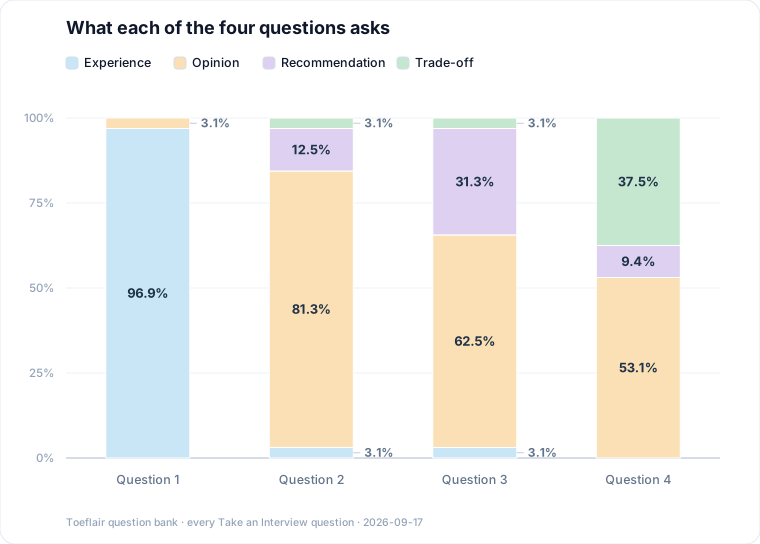
Question 1 is one thing and one thing only. From there opinion takes over, recommendation quietly grows through the middle — and the trade-off question, which barely exists in the first three slots, takes over more than a third of the last one.
Pool all four slots together and the overall diet comes out like this:
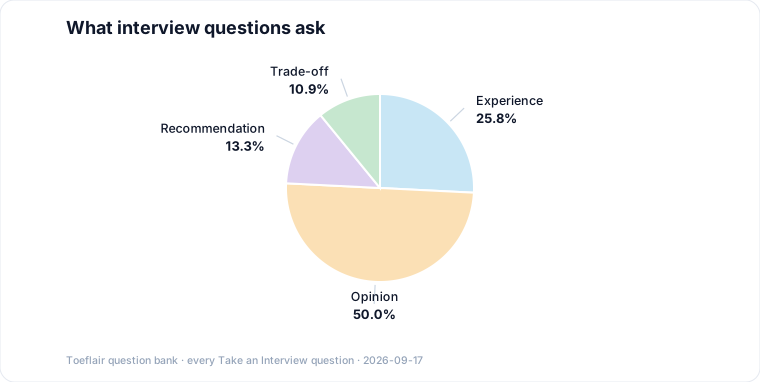
Half the task is opinion. But the order matters more than the mix: you open on your own life, which is the easiest material you’ll ever be handed, and you close on a trade-off, which is the hardest. Budget accordingly — a lot of people spend their best energy on question 1 and arrive at question 4 with nothing left.
And because each question follows on from the last, a memorized answer stops working the moment the interviewer picks up something you actually said. We made that case at length in why memorized answers fail the interview.
What the scenarios cover
Scenario range matters for a simple reason: unfamiliar settings cost you vocabulary you’d otherwise have free.
The two tasks cover deliberately different ground. Listen & Repeat stays in places where someone would plausibly be giving you instructions out loud — our sets run Campus, Community, Nature, Lifestyle and Health, with Campus alone accounting for more than a third. Tours, front desks, workshops, orientations.
Take an Interview is much broader, because it needs topics you can hold an opinion about: eleven different areas, led by Lifestyle, Technology and Education, then Community, Culture, Health, Relationships, Work, Travel, Psychology and Financial.
So the preparation differs. For Listen & Repeat, what pays is being comfortable with the register of public instructions. For the interview, it’s having something to say about ordinary life — which is less about vocabulary lists and more about having opinions ready in English at all.
What to actually do with this
Three things follow from the numbers above:
- Expect the ladder, and spend your attention at the top of it. Sentences 1 and 2 are warm-up. If you’re using them to find your rhythm, that’s fine — just know the demanding part starts at 6.
- On sentences 6 and 7, listen for structure, not words. More than half carry a subordinate clause, and three quarters of those front-load it. Catch the boundary and repeat in two chunks.
- In the interview, pace for question 4. You open on your own experience and close on a trade-off. The hard one is last.
None of this requires a list of questions, which is the point — the shape transfers and the contents don’t.
If you want to feel the ladder rather than read about it, our Listen & Repeat practice plays a set and scores each sentence separately, so you can see exactly where in the seven your accuracy falls off. Take an Interview practice runs the four-question arc with follow-ups. Both are free to try, and if you’re curious how the scoring works underneath, we’ve explained how AI grades TOEFL speaking.
The writing side works the same way and answers a different question. We ran the same measurement on the Write an Email bank: what TOEFL email questions actually ask you to do shows that every prompt lists exactly three required points, and that the request almost always lands in the third one.
Figures in this post come from every Listen & Repeat sentence and every Take an Interview question in the Toeflair question bank, measured 2026-09-17. Our questions are generated to the three-tier length structure the task uses, across a range of scenarios; the tier-level comparisons above describe our own bank.