


In short: The Integrated Writing task left the TOEFL on January 21, 2026. Its core skill, summarizing a lecture against a reading, is no longer scored anywhere in Writing. Four writing skills it trained still are, and our data shows where students still lose points on the new tasks.
The old Integrated Writing task gave you 3 minutes to read a short passage, then played a lecture of about 2 minutes, once. In general, the lecture argued against the points raised in the passage. You had 20 minutes to summarize the lecture and explain how it related to the reading.
What was removed, and what replaced it
The Writing section changed twice in three years. The Independent essay went first on July 26, 2023, replaced by Academic Discussion. That cut the section from 50 to about 29 minutes.
Integrated followed on January 21, 2026. Since then, no Writing task asks you to read a passage and listen to a lecture first.
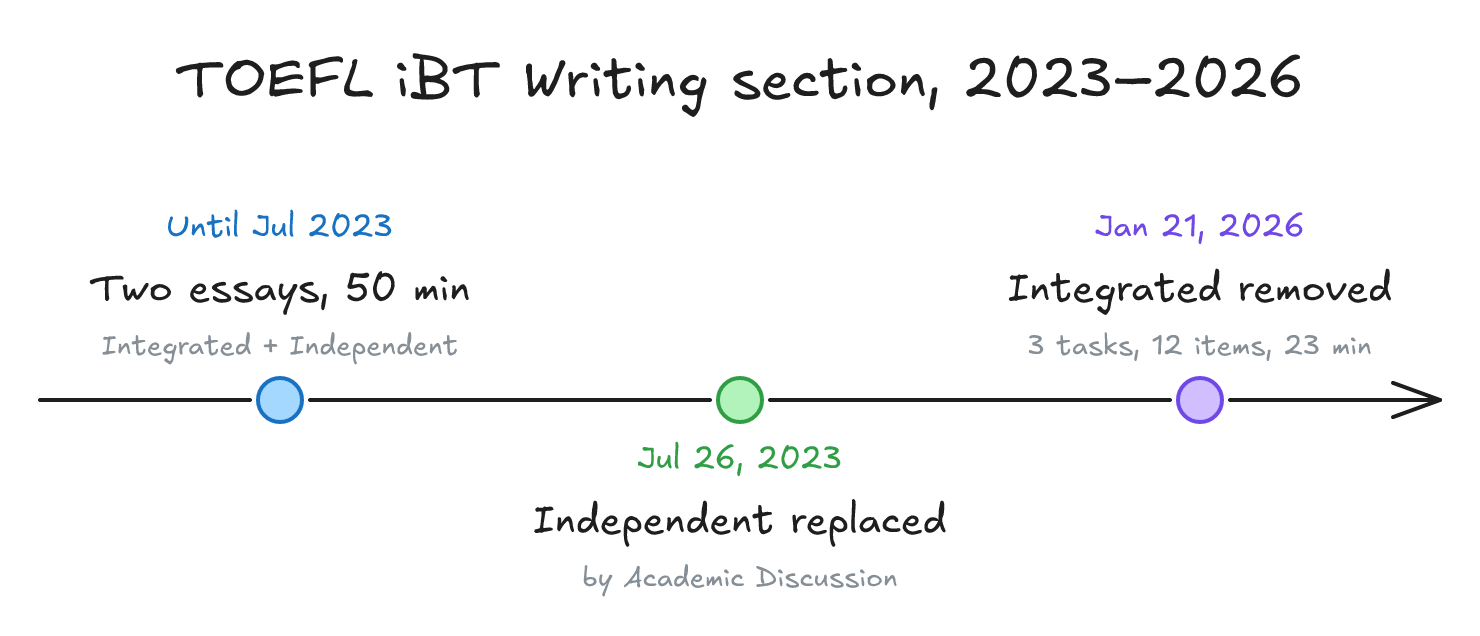
The new section takes 23 minutes: 10 Build a Sentence items, then a single Email Writing task and a single Academic Discussion task. Each new task type gets its own walkthrough in our breakdown of every 2026 change. To practice the two that need real writing, start with Email Writing and Academic Discussion.
ETS’s current Writing page lists only the new tasks. Its Integrated Writing transcript and rubric are still live on ets.org with no “retired” label, which is why so many guides still teach the task. Your prep material describes the old test if it mentions any of these:
- two writing tasks, or a Writing section of 50 or about 29 minutes
- reading a passage and listening to a lecture before you write
- a 150–225 word target, or section scores on a 0–30 scale
- an Independent essay
The Official Guide to the TOEFL iBT Test is the quickest check. McGraw Hill lists the Eighth Edition, published September 8, 2026, as the first one written for the January 2026 test.
The writing skills that still count
The Integrated Writing rubric weighed the accuracy of the lecture’s points and arguments, and their connection to the reading. Since the reading stayed on screen while you wrote, most of that weight fell on the lecture. A high-scoring response “selects the important information from the lecture” and presents it accurately against the reading. No 2026 Writing task asks for that.
Integrated Writing also leaned on two listening-side skills: taking notes while the lecture played and summarizing what you heard. Neither appears in the 2026 Writing section. Summarizing what you read still does, along with the other skills below, and they matter even more for a high score.
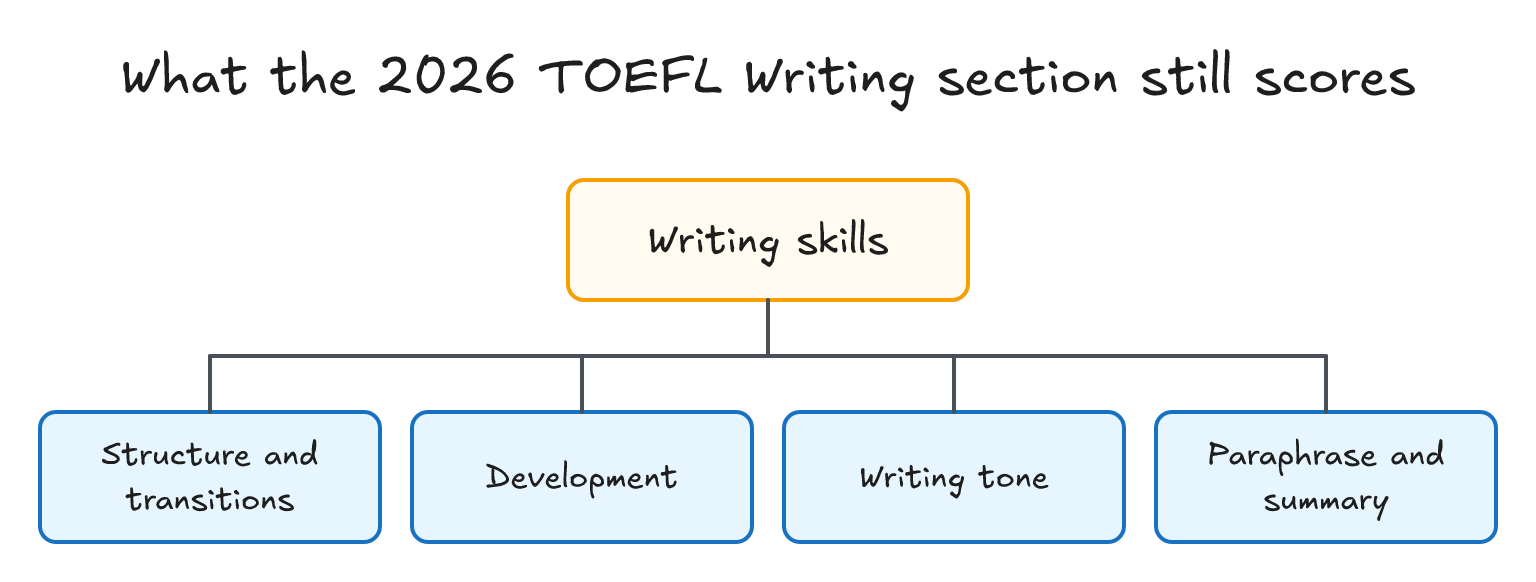
Structure and transitions
Structure is the plan a reader can follow, made of a main point, the support for it and a clear ending. Each part does one job and sits where the reader expects it. In practice that usually means an opening, one or two supporting points, and a close. ETS raters scored Integrated responses partly on organization, and the 2026 section still measures how well you “organize ideas”.
Transitions are how you show the reader the links between those parts. Each new paragraph should signal how it relates to the last one, whether it adds a point or turns against it. Inside a paragraph, a connecting word or phrase tells the reader whether the next sentence is a cause, a result or a step further. The Email Writing scoring guide names “organization of information” outright.
Development
Development comes down to two things, and the first is richness. A specific example, a number or a short scene does more than a general claim, and thin details make even a sound point read as unsupported. Specific details are also where precise vocabulary earns its place, as long as it serves the point rather than decorating it. ETS’s 2026 scoring guide for Academic Discussion rewards “relevant and well-elaborated explanations, exemplifications and/or details”.
The second is logic. Each detail has to back an argument, and each argument has to support your main point, as its cause or as a step further. A word like “therefore” only tells the reader that one idea leads to the next; development is whether it really does. In Email Writing, the scoring guide rewards elaboration that “effectively supports the communicative purpose”.
Writing tone
Your tone should change with who is reading. Integrated Writing was read only by a rater, so an academic tone covered it, with precise claims and no slang.
The 2026 tasks ask for two. Academic Discussion still asks you to “write in an academic tone”. Email Writing is scored on social conventions such as politeness and register, so you write to a professor (“Dear Professor Lee, I’m writing to ask…”) differently than to a roommate (“Hi Sam, quick question…”).
Paraphrase and summary
Paraphrase keeps the meaning of a source but puts it in your own words and sentence structure. Summary keeps only the key points and evidence, in fewer words and in the tone of your own response. Integrated Writing and both new tasks ask for both, but for different purposes.
In Integrated Writing, you picked points from the reading to set up the lecture’s points and evidence. In Email Writing and Academic Discussion, you summarize the scenario or your classmates’ posts to set up and support your own point.
Say a classmate writes “Online classes save students time and money.” Copying that line adds nothing of yours. “Kelly is right that studying online cuts commuting and tuition costs, but it also cuts the chance to ask a question after class” restates her point and uses it to set up yours. Both 2026 scoring guides give a 1 out of 5 to a response whose language is “mostly borrowed from the stimulus”.
Where students still lose points
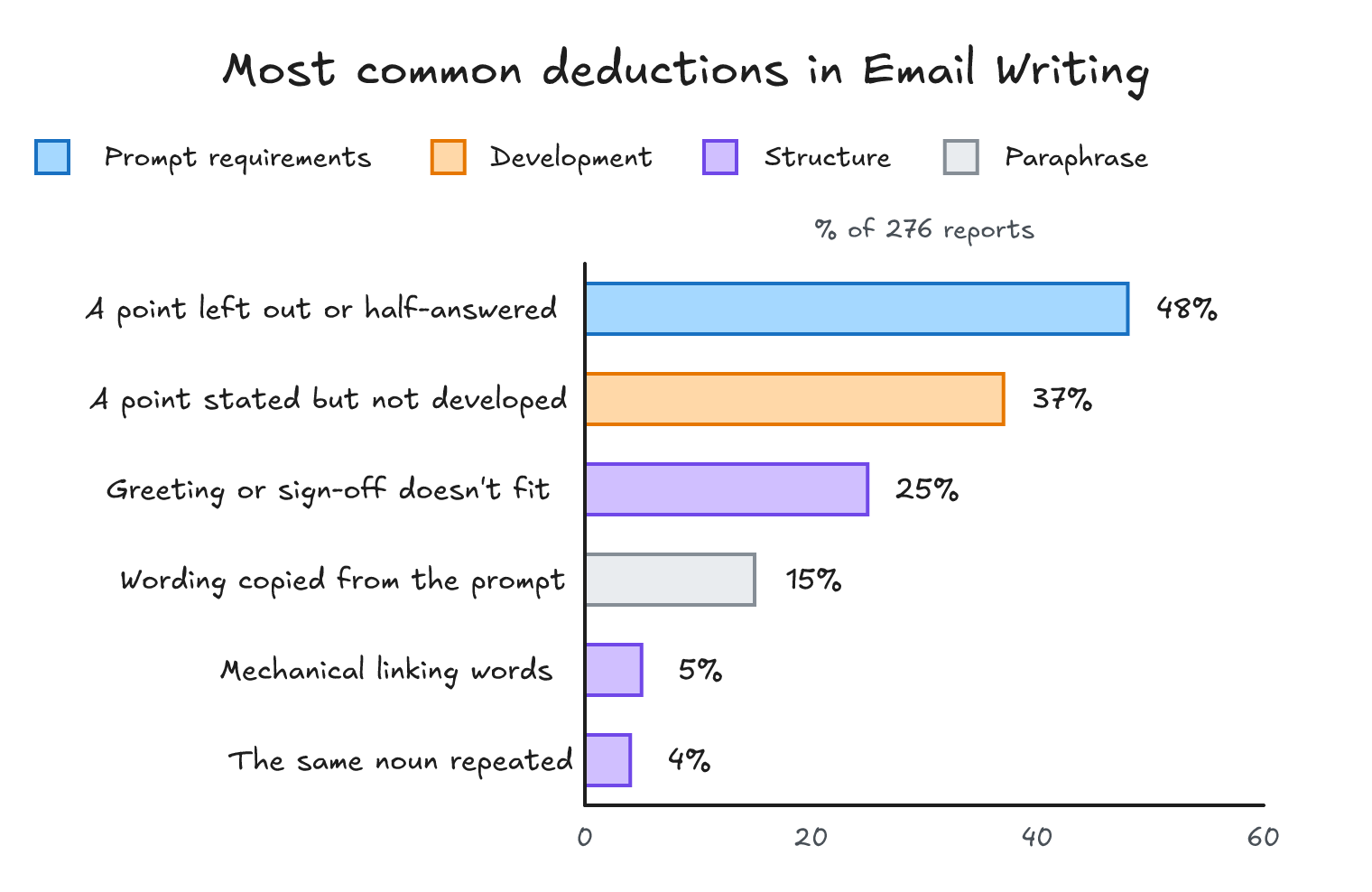
We took a sample of 400 Email Writing and Academic Discussion reports our grader produced between July 22 and October 27, 2026, leaving out test accounts, and counted every deduction. Leaving aside vocabulary and spelling slips, three kinds come up most.
Prompt requirements left undone
In Email Writing, about one in four reports left out a point the prompt asked for. Counting half-answered points too, 48% of reports had at least one point that wasn’t fully answered, and about two in three students ran into this at least once. Partly answered points outnumbered outright misses by more than three to one, because our grader counts a vague or generic attempt as partly answered, never as answered.
Integrated Writing checked whether you made the link between the lecture and the reading clear. In Email Writing, the more common loss is a point that is mentioned but not actually answered. In Academic Discussion, under one in ten reports restated a classmate’s view without adding a new angle.
Your roommate emailed asking if their friend can stay in your shared apartment for two weeks. Reply, addressing:
- whether you agree
- any conditions or concerns
- what should happen during the visit
A reply that says “sure, just let me know the details” touches the first point and waves at the third. It skips the second entirely, so that is one point answered, one partly answered and one missed. We walk through how each kind of point gets answered in our guide to TOEFL email questions.
Development that falls short
About a third of reports in both tasks lost points for a point that was stated but never developed, with no reason, example or extension behind it. In Academic Discussion it is the most common deduction outside vocabulary and grammar. A smaller group there made sweeping claims with nothing specific behind them.
Structure that’s off or mechanical
In Email Writing, about one in four reports lost points on the frame of the email itself: a salutation that doesn’t fit the recipient, or a missing closing. Mechanical linking words, such as a “Firstly… Secondly…” stack or a connector on every sentence, show up in under one in ten reports. So does repeating the same noun where a pronoun or a substitute would read better.
What I’d drop if I were still on the old books
I took the old-format TOEFL seven times between 2018 and 2022. Writing was my least predictable section. I scored 28, then 25, then 22, before a paid essay course got me back to 27–28. I tell the whole story in why I’m rebuilding TOEFL prep.
Most Integrated practice is built around the lecture. ETS’s own advice for the task was to take notes on lectures and compare two articles on the same topic. None of that earns a point in the 2026 Writing section. Today I’d drop the lecture notes and the Integrated template first.
What I’d keep is the habit that course finally gave me: checking each sentence against what was actually asked. Answering the point, not just mentioning it, is what the new tasks still score. Now I’d spend that time on Email Writing and Academic Discussion practice, plus the method in how to practice TOEFL Writing.
Further reading
- ETS — TOEFL iBT Writing section — ets.org/toefl/test-takers/ibt/about/content/writing.html (the three 2026 task types and what each measures).
- ETS — TOEFL iBT test specifications, 2026 — ets.org/pdfs/toefl/toefl-ibt-test-specifications-2026.pdf (item counts and the 23-minute Writing section).
- ETS — Inside the TOEFL Test: Writing Integrated Question — ets.org/toefl/test-takers/ibt/transcript/writing-integrated.html (the pre-2026 task: timings, word range, 0–5 score).
- ETS — TOEFL iBT enhancements debuting July 2023 — ets.org/news/press-releases/toefl-ibt-enhancements-debuting-july-2023.html (Academic Discussion replacing the Independent essay).
- ETS — TOEFL iBT Writing scoring guides, 2026 tasks — es.ets.org/content/dam/ets-org/pdfs/toefl/writing-rubrics.pdf (the 0–5 scoring guides for Email Writing and Academic Discussion).
- ETS — TOEFL iBT Writing rubrics, pre-2026 — ets.org/content/dam/ets-org/pdfs/toefl/toefl-ibt-writing-rubrics.pdf (the Integrated Writing scoring rubric).
- McGraw Hill — The Official Guide to the TOEFL iBT Test, Eighth Edition — mheducation.com (the first edition written for the January 2026 test).